
SYKE Proficiency Test 5/2010
|
|
|
- Seppo Kahma
- 9 vuotta sitten
- Katselukertoja:
Transkriptio

1 REPORTS OF FINNISH ENVIRONMENT INSTITUTE SYKE Proficiency Test 5/2010 Gross and net calorific values in flues Mirja Leivuori, Minna Rantanen, Kaija Korhonen-Ylönen and Markku Ilmakunnas Finnish Environment Institute
2

3 REPORTS OF FINNISH ENVIRONMENT INSTITUTE SYKE Proficiency Test 5/2010 Gross and net calorific in flues Mirja Leivuori, Minna Rantanen, Kaija Korhonen-Ylönen and Markku Ilmakunnas Helsinki 2011 Finnish Environment Institute
4 REPORTS OF FINNISH ENVIRONMENT INSTITUTE Finnish Environment Institute SYKE The organizer of the intercomparison test: Finnish Environment Institute SYKE, Laboratories Hakuninmaantie 6, Helsinki phone , fax Publication is available only in the internet : ISBN (PDF) ISSN (online)
5 CONTENT 3 ALKUSANAT/PREFACE 5 1 INTRODUCTION 6 2 ORGANIZING THE PROFICIENCY TEST Responsibilities Participants Samples and delivery Homogeneity studies Feedback from the pro ciency test Analytical methods Gross and net calori c value Measurement of carbon, hydrogen, nitrogen, sulphur, moisture and ash Processing of the data Testing of normality of data, outliers and replicate results Assigned values and uncertainties Standard deviation for pro ciency assessment and z score 10 3 RESULTS AND CONCLUSIONS Results Analytical methods and status to the results Ash, moisture and elemental measurements Gross and net calori c value Uncertainties of the results Estimation of emission factor EVALUATION OF PERFORMANCE 15 5 SUMMARY 16 6 YHTEENVETO 17 7 REFERENCES 17
6 4 APPENDICES Appendix 1 Participants in the pro ciency test 5/ Appendix 2 Preparation of the samples 22 Appendix 3 Testing of the samples 23 Appendix 4.1 Comments sent by the participants 25 Appendix 4.2 Comments to the participants 26 Appendix 5.1 Analytical methods 27 Appendix 5.2 Signi cant differences in the results reported using different standard methods 33 Appendix 5.3 Results grouped according to the methods 34 Appendix 6 Evaluation of the assigned values and their uncertainties 40 Appendix 7 Terms in the result tables 41 Appendix 8 Results of each participant 42 Appendix 9 Summary of the z scores 53 Appendix 10 Measurement uncertainties reported by the laboratories 55 Appendix 11 z and zeta scores of laboratories 62 DOCUMENTATION PAGE 68 KUVAILULEHTI 69 PRESENTATIONBLAD 70
7 ALKUSANAT 5 Suomen ympäristökeskus (SYKE) on toiminut ympäristöalan kansallisena vertailulaboratoriona vuodesta 2001 lähtien. Toiminta perustuu ympäristöministeriön määräykseen, mikä on annettu ympäristönsuojelulain (86/2000) nojalla. Vertailulaboratorion tarjoamista palveluista yksi tärkeimmistä on pätevyyskokeiden ja muiden vertailumittausten järjestäminen. Vertailumittausten järjestäminen täyttää kansainvälisten ohjeiden ISO/IEC Guide 43-1 ja ILAC-G13 asettamat vaatimukset. SYKEn laboratoriot on FINAS-akkreditointipalvelun akkreditoima testauslaboratorio T003 ja vertailumittausten järjestäjä PT01 (Proftest SYKE, www. nas. ). Tämä pätevyyskoe on toteutettu SYKEn vertailulaboratorion pätevyysalueella ja se antaa tietoa osallistujien pätevyyden lisäksi tulosten vertailukelpoisuudesta myös yleisemmällä tasolla. Pätevyyskokeen onnistumisen edellytys on järjestäjän ja osallistujien välinen luottamuksellinen yhteistyö. Parhaat kiitokset yhteistyöstä kaikille osallistujille! PREFACE Finnish Environment Institute (SYKE) has served as the National Reference Laboratory in the environmental sector designated by the Ministry of the Environment under the section 24 of the Environment Protection Act (86/2000) since The duties of the reference laboratory service include providing pro ciency tests and other interlaboratory comparisons for analytical laboratories and other producers of environmental information. The pro ciency testing service is a part of the SYKE laboratory management system based on the standard EN ISO/IEC The SYKE pro ciency testing service also conforms to the requirements of ISO/IEC GUIDE 43-1 and ILAC G-13. The SYKE laboratories have been accredited by the Finnish Accreditation service as the testing laboratory T003 and as the pro ciency testing provider PT01 (Proftest SYKE, www. nas. ). This pro ciency test has been carried out under the scope of the SYKE reference laboratory and it provides information about performance of the participants as well as comparability of the results at more general level. The success of the pro ciency test requires con dential co-operation between the provider and participants. Thank you for your co-operation! Helsingissä 4. Helmikuuta 2011 / Helsinki 4 February 2011 Laboratorionjohtaja / Chief of laboratory
8 1 INTRODUCTION 6 The Finnish Environment Institute (Proftest SYKE) carried out the pro ciency test for the analysis of the gross and the net calori c value as well as for content of ash, carbon, hydrogen, nitrogen, sulphur and analytical moisture content in fuels in September The samples were prepared from peat (B1) and coal (K1). Additionally, the participants were asked to estimate/calculate the emission factor for both samples. The test was carried out in accordance with the international guidelines, ISO/IEC Guide 43-1 [1], ISO/IEC [2], ISO [3] and IUPAC Recommendations [4]. The Proftest SYKE has been accredited by the Finnish Accreditation Service as a pro ciency testing provider (PT01, www. nas. ). Proftest SYKE is the accredited pro ciency test provider on the eld of the present test. The pro ciency test performed as the joint work with the working group (WG) of the European co-operation for Accreditation (EA) for Interlaboratory Comparisons (EA WG ILC in Testing) and the data will be con dentially handled in the work of this WG. 2 ORGANIZING THE PROFICIENCY TEST 2.1 Responsibilities Organizing laboratory: Finnish Environment Institute (SYKE), Laboratories Hakuninmaantie 6, Helsinki tel , fax Subcontractors: The peat sample B1 prepared by Enas in Jyväskylä (Finland) and the coal sample K1 was prepared by Helsinki Energia (Finland). Both samples were homogenized and divided to the sub samples at the laboratory of Water Protection Association of the Kokemäenjoki River in Tampere (Finland, accredited testing laboratory T064 by the Finnish Accreditation Service, www. nas. ). The samples were tested at Mibrag mbh in Zeitz (Germany, the accredited testing laboratory DGA-PL by the Deutsche Geselleschaft für Akkreditierung mbh, The calori c value of the peat sample was, additionally, tested at the laboratory of Ramboll Analytics in Vantaa (Finland, the accredited testing laboratory T039 by the Finnish Accreditation Service, w w w. n a s. ). The responsibilities in organizing the pro ciency test were as follows: Mirja Leivuori, coordinator Kaija Korhonen-Ylönen, substitute of coordinator Keijo Tervonen, technical assistance Sari Lanteri, technical assistance Markku Ilmakunnas, technical assistance and layout of the report. The analytical expert was: Minna Rantanen, Ramboll Analytics

9 2.2 Participants 7 In this pro ciency test (PT) totally 58 laboratories participated, from which 16 were from Finland and 41 from other European countries and one laboratory from Asia (Appendix 1). The sample testing laboratories Mibrag mbh has the code 60 and Ramboll Analytics has the code 59 in the result tables. 2.3 Samples and delivery The preparation of the samples is presented more detailed in Appendix 2. The sample B1 was the peat sample from the Finnish marshland. The material was air dried and grounded by the mill with 500 µm sieve before homogenization and sample dividing. The coal sample (K1) was prepared from a Russian crushed coal. The material was air dried and grounded to particle size < 200 µm before homogenization and sample dividing. The samples were delivered 14 September They were requested to be analyzed and reported before 7 October The samples and the requested measurands were as follows: In the covering letter with the samples was noted that the moisture content of the analysis had to be measured as the rst measurement after storing samples closed one day on the measuring laboratory. The samples were asked to homogenate before measurements and to store in dry place at room temperature. Additionally, the participants had the possibility to estimate/calculate the emission factor (as received) for the both samples. For this estimation/calculation the organizer of this PT reported the total moisture contents as received (M ar ) for peat sample B1 44.3% and for coal sample K1 11.2% in the covering letter of the samples. 2.4 Homogeneity studies Homogeneity of the samples B1 and K1 was tested by analyzing the gross calori c value and the ash content as replicate determinations from fteen subsamples. The homogeneity of the gross calori c value of the peat sample B1 was tested from eight additional samples by other laboratory due to the somewhat high variability of the rst results. After this additional testing the peat sample was considered also as homogenous (Appendix 3). Moreover carbon, nitrogen and hydrogen from fteen and sulphur from eight subsamples were measured. According to the all homogeneity test results the both samples B1 and K1 were considered homogenous. Particle size distribution was also tested from one sub sample of peat (B1) and coal (K1). The results show that the samples were appropriate for measurement of calori c value (Appendix 3).
10 2.5 Feedback from the pro ciency test 8 Appendix 4.1 contains the comments sent by the participants. The comments were mainly relating to the data input protocols in the laboratories. The provider gives some comments to the participants considering mainly the reporting of the results in Appendix Analytical methods Gross and net calori c value The analytical methods based on different standard methods were used for the measurements in the PT. The used analytical methods of the participants are shown in more detail in Appendix 5.1. Mostly, the standard methods or the CEN/technical speci cation were used for measurement of calori c value (CEN/TS [5], ISO 1928 [6], DIN [7], ASTM D [8]). A few laboratories were used some national standards (e.g. lab 29, 44). The participants used mainly the sample amount g for measurement of the calori c value. Generally, the analyses were carried out from air dried samples (Appendix 5.1). The measurements of calori c value were mainly done by IKA, LECO and PARR equipments. The volume of water added into a reaction bomb varied mainly from 1 to 10 ml depending on the type of measuring equipment (Appendix 5.1). In the calibration used benzoic acid from 8-10 different producers. Mainly, the calibration standard was used without correction to the value given in the certi cate. In the calculation of gross calori c value (q-v,gr,d) various correction methods were used. Basically, fuse wire, ignition, acid, cotton, moisture, nitrogen and sulphur corrections were used. However, the participants used several combinations of them (Appendix 5.1). In the calculation of net calori c value (q-p,net,d) different combinations of correction factors were used as well. Mainly, the measured hydrogen content with or without nitrogen and oxygen corrections was used. However, in some cases also calculated hydrogen content was used for corrections Measurement of carbon, hydrogen, nitrogen, sulphur, moisture and ash In the PT several standard methods or technical speci cations were used mainly for measurement of different parameters as follows: C, H and N: CEN/TS [9], ISO/TS [10], ASTM D 5373 [11] S: ASTM D 4239 [12], CEN/TS [13], ISO 334 [14] Analytical moisture content: CEN/TS [15], ISO 589 [16], DIN [17], ASTM D 5142 [18] Ash content: CEN/TS [19], ISO 1171 [20], DIN [21], ASTM D 5142 [18] However, in some cases other international standards or national standards were used. For example, sulphur was measured using standards: ASTMD 3177 (lab 28), ISO-351, ISO (lab 51) or DIN DIN (lab 46). For moisture measurements were used also standard: ASTM D 3173 (lab 28), ISO (lab 35, 47, 51), ISO or ASTM D 3302 (lab 57). Additionally, one laboratory used infrared moisture analysis (21). Carbon, hydrogen and nitrogen were also measured using standards: ASTM D 3178 (lab 37), ASTM D (lab 46) or ISO 1028 (lab 47). Also some national standards (e.g. lab 29, 37, 38, 4, 42, 44, 48, 49) or in-house methods (EDXRF, lab 57) were used.
11 9 Carbon, hydrogen and nitrogen were measured by using different equipments (e.g. VARIOMAX, LECO, ELTRA, ELTRA CHS, Appendix 5.1). Different elemental analyzers (e.g, ELTRA, LECO, Appendix 5.1) were also used for measurements of sulphur. Sulphur was measured also by using O 2 -combustion and IC-measurement and some other techniques. Ash content was measured also using some other standards, e.g. ASTMD 3174 (lab 28, 35, 42) and some national standards (e.g. lab 29, 37, 38, 41) or in-house methods were reported as well. Ash content was determined gravimetrically by heating mainly at the temperature 550 o C (Sample B1) or 815 o C (Sample K1). Also some other temperatures were used for ash content measurements (Appendix 5.1). 2.7 Processing of the data Testing of normality of data, outliers and replicate results Before the statistical treatment, the data was tested according to the Kolmogorov-Smirnov normality test and the outliers were rejected according to the Hampel test for calculation of the mean value (H in the results sheets). Also before the robust calculation some extreme outliers were rejected in case that the results deviated from the robust mean more than 50 %. The replicate results were tested using the Cochran-test (C in the result sheets). If the result was reported < DL (detection limit), it has not been included in calculation of the results (H in the results sheets) Assigned values and uncertainties The robust mean was used as the assigned value for each measurement of the sample B1 and K1 (Appendix 6). In the calculation of the robust mean outliers were not normally rejected, but they were iterated before the nal calculation of the robust mean. However, in this pro ciency test some extreme results (at most 1-7 results/measurement) had to be rejected because of rather strict requirements for reproducibility given in the standards for analysis described in the covering letter of the samples. Especially in estimation of the assigned value of gross and net calori c value, the base for extreme value was either the anomalous calori c value or anomalous value in the measured moisture or/and element value used in the calculation or the reported results were not according to the given instructions. In addition, a few laboratories reported the anomalous values in measurement of the gross and net calori c value, which may indicate systematic errors in measurement. Also the mean value (after using the Hampel outlier test) and the median value of the data were calculated, which were quite near with the assigned values (Table 1). Also the results of homogeneity testing of the samples were used as background information in estimation of the assigned values. Additionally, the calculated assigned values of the calori c values were compared with the results obtained in the kernel density plots [4]. When using the robust mean of the participant results as the assigned value, the uncertainties of the assigned values for calori c values varied from 0.18 % to 0.28 %. For the other measurements the uncertainty varied from 0.34 % to 5.6 % (Appendix 6). The participants also calculated emission factors (EF) according to the given total moisture contents as received (M ar ) for the samples and the results were evaluated as well. According to the evaluation of results at least laboratories 34 and 43 were not calculated the emission factor for peat as requested. The case was the same for the emission factor of coal reported by the laboratory 43. These results were excluded from the assigned value calculation. For these laboratories, the performance evaluation of emission factor was not satisfactory, thus weakening the reliability of the performance evaluation of EF as a whole. After reporting the preliminary results in October 2010 no corrections had done to the assigned values.
12 Standard deviation for pro ciency assessment and z score For the total standard deviation for pro ciency assessment used in the calculation of the z score was used the target value for reproducibility recommended in the international standards or technical speci cations for measurement of calori c values and other determinants [5, 6, 9, 10, 12, 19, 20, 21]. The reproducibility recommended in the standards was mainly ful lled for the gross calori c values (± 300 J g -1 ). For the net calori c value the reproducibility was increased to ± 368 J g -1 for the sample B1 and to ± 374 Jg -1 for the sample K1. The reason was partly the variability of the results and the missing of clear reproducibility information for the net caloric value in the standard methods [e.g. 5-8]. In calculation of net calori c value there are more uncertainty sources than in calculation of gross calori c value. Particularly, on the nal results of net calori c value uncertainty and errors of other measurements (i.e. moisture, S, H) can affect. For some other measured parameters (i.e. C, H, N, S and ash) the total standard deviation for pro ciency assessment had to be increased from the reproducibility presented in the standard methods. However, noticeable was that for H and ash the reproducibility of results were better than in the previous PT and the total standard deviation was able to lower in this PT when compared to the previous PT [22]. The results of analysis moisture (M) have not been evaluated because of rather great variation of the results, but the assigned values for both sample types are presented. The performance evaluation was carried out by using z scores (Appendix 7). In the performance evaluation z scores were interpreted as follows: z 2 satisfactory results 2 < z < 3 questionable results z 3 unsatisfactory results The performance evaluation of participants using calculated z scores are presented in Appendix 8. The reliability of the assigned value was tested according to the criterion: u s p 0.3, where u is the standard uncertainty of the assigned value (the uncertainty of the assigned value (U) divided by 2) and s p the standard deviation for pro ciency assessment (total standard deviation divided by 2). The test criterion for the reliability of the assigned value was ful lled in every case, which indicated that the assigned values were very reliable. The reliability of the target value for the total deviation and the reliability of the corresponding z score were estimated by comparing the deviation for pro ciency assessment (s p ) with the robust standard deviation of the reported results (s rob ). The criterion s rob < 1.2* s p was ful lled in every case. Due to this the evaluation of performance is reliable for this pro ciency test. The performance was not evaluated for moisture contents partly due to high variability between the results. The evaluation of emission factor (EF) is only indicative due to the noticed calculation errors for the both sample types. After reporting the preliminary results in October 2010 no corrections had done to the standard deviations for the pro ciency assessment.
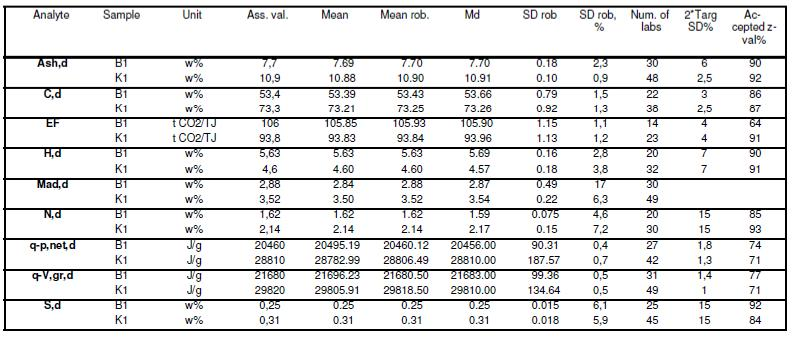
13 3 RESULTS AND CONCLUSIONS Results The summary of the results is presented in Table1. The reported results and their uncertainties grouped by the measurement methods are presented graphically in Appendix 5.3. Explanations to terms used in the result tables are presented in Appendix 7. The results and the performance of each laboratory are presented in Appendix 8. The summary of z scores is shown in Appendix 9. The measurement uncertainties reported by the laboratories grouped according to the evaluation procedure is reported in Appendix 10. The comparison of z and zeta scores (Appendix 7) is shown in Appendix 11. Table 1. Summary of the result in the pro ciency test 5/2010. Ass. Val. the assigned value Mean the mean value Mean rob robust mean Md the median value SD % the standard deviation as percent SD rob the robust standard deviation SD rob % the robust standard deviation as percents Num of Labs the number of participants 2*Targ. SD% the total standard deviation for pro ciency assessment at 95 % con dence level (2*s p ) Accepted z-val% the satisfactory z scores: the results (%), where z 2. The robust standard deviation of results was lower than 2 % for 50 % of the results and it was lower than 6 % for 78 % of the results (Table 1). For nitrogen (N) in the sample K1 and for sulphur (S) in the sample B1 the robust standard deviation was 7.2 and 6.1 %, respectively. In measurement of moisture the robust standard deviation was 6.3 % in the coal sample and more than duplicated (17 %) in measurement of the peat sample. The standard deviations of the results in this PT were nearly in the same range than in the previous respective PT SYKE 5/2009 [22], where the deviations varied from 0.5 % to 11 %. In this PT the participants were requested to report the replicate results for all measurements. The results of the replicate determinations based on the ANOVA statistical handling are presented in Table 2. The international standards or technical speci cations relating to measurements in fuels recommend the targets for the repeatability.
14 12 In particular, in measurement of the calori c values, the requirement for the repeatability is ± 120 J/g. In this PT the requirements for the repeatability in measurement of the gross calori c value are 0.55 % for the sample B1 and 0.40 % for the sample K1 and in measurement of the net calori c value 0.59 % and 0.42 %, respectively. In each case, the obtained repeatability in measurement of the gross calori c value and the net calori c value was lower than the repeatability requirement (Table 2, the column s w %). The repeatability was mainly acceptable only for carbon C in the elemental measurements (Table 2, the column s w %). The summary of the robustness of the methods, the ratio s b /s w, is presented in Table 3. The ratio s b / s w should not be exceeded 3 for robust methods. However, in Table 3 is seen that in many cases the robustness exceed the value 3. For the gross calori c value, the ratio s b /s w, was 2.9 % (the sample B1) and 4.6 % (the sample K1), for the net calori c values 5.3 % and 6.0 %, respectively. The high ratio s b /s w for the net calori c value was at least partly resulting from variable procedures used in calculation of the results. Table 2. Summary of repeatability on the basis of duplicate determinations (ANOVA statistics). Table 3. The robustness (s b /s w ) of the replicate results in the PT5/ Analytical methods and status to the results In Appendix 5.1 is summarized the used analytical methods in the pro ciency test. The difference between the average concentrations of elements measured by different sample preparation methods was tested using the t-test. The results of the t-test are shown in Appendix 5.2. In Appendix 5.3 is presented the results of participated laboratories grouped based on used different standard methods.
15 Ash, moisture and elemental measurements In measurement of the ash content only a few laboratories reported too high or too low values, and different techniques have not clearly affected the results (Appendix 5.3). In the ash content, no statistically signi cant difference between the results was noticed. The analysis moisture (M ad ) was measured using different standard methods (Appendices 5.1 and 5.3). There was the statistically signi cant difference between the moisture results in the sample K1 measured by the standards ISO 589 and DIN and between DIN and ASTM D 5142 (Appendix 5.2). The differences between the results can be varied from the amounts of used sample amount for analyses, the drying time at an oven and drying atmosphere at an oven or the humidity content of the ambient. The methods ISO 589 and DIN are based on gravimetric methods and ASTM D 5142 is instrumental procedure. It was dif cult to estimate the correct values for analysis moisture at pro ciency tests as a result above mentioned reasons. The correct measurement of moisture is important, because it plays a signi cant role in the calculation of the calori c values. In measurement of carbon, nitrogen, hydrogen and sulphur different standard methods were used (Appendices 5.1 and 5.3). Only for the results of sulphur in the sample K1 there was the statistically signi cant difference between the standards ISO 334 and ASTM D 4239 (Appendix 5.3). The difference can be due to the various measuring procedures. ASTM D 4239 is an instrumental procedure using high temperature tube furnace combustion and ISO 334 is Eschka method based on mainly gravimetric technique. ASTM D 4239 is a rapid method and ISO 334 is time consuming containing several analysis steps Gross and net calori c value In the Appendices 5.1 and 5.3 are shown the results of the gross calori c values for the samples B1 and K1 with the reported information of the used standard method and the more detail information of the used methods. Basically, there was no clear difference between the gross calori c values obtained using the different standard methods and no statistically signi cant difference between the results were found. For the laboratories 26 (the sample K1 and B1) and 47 (the sample K1) the deviation of the net calori c value is evident due to the errors in the data reporting (Appendices 4.1, 8). In many cases, the anomalous result was explained by the errors in the data reporting and/ or errors in the measurement. There was some variance between results, but mainly the gross calori c values and net calori c values were between the acceptable variances. The main mistakes might be due to erroneous data handling and calculations. The reasons for deviated results are fairly complicated to obtain in this PT, because there might be several errors effecting on the nal results at the same time. There are several factors, which have to be taken into account measurement of calori c value: Sample should be mixed well before analyses are carried out. Analytical moisture and calori c value should be measured at a same time (within a few hours), if the gross calori c value is analyzed from air dried sample. Analytical moisture has a great effect for calculation the gross calori c value as a dry weight basis. The porous fuel material adsorbs moisture very easily and the changes in the moisture content of the laboratory air can cause inaccuracies to the calori c value reported as a dry weight basis. In measurement of calori c value from the dried sample, moisture can absorb into a sample very easily from a laboratory environment. The sample should be analyzed as soon as possible after drying or a dried sample should keep in a small, effectively closed small container until the calori c value analysis is carried out.
16 14 The coal samples can be analyzed in a power form. Usually biomass and peat samples shall be tested in a pellet form or in power form in a closed combustion bag or capsule. In the future, it could be valuable to ask participants report more information from the way of sample handling in the analyzing step as this can be an important issue in the verifying of test results. If the sample contains a high amount of sulphur and nitrogen, the correction for sulphur and total acids can affect to a great extent, especially in the case of coal samples. The laboratory has to take into account the calibration conditions, whether benzoic acid has been weighed in air or in vacuum (on the basis of a certi cate). Further, in the measurement of the sample the conditions should be similar as during the calibration process (e.g. a pressure, an amount of calorimeter water, a correction for total acids). The mass of the sample (g) has to been adequate to meet the valid temperature rise and the linear calibration range. Stability of the calorimeter has to been checked before sample measurements with the certi ed benzoic acid. The calculation of gross and net calori c value should be based on the formulas of the international standards. If in the calculation any literature values for the parameters needed are used, those should be reported with the calori c values. To get more accurate results the measured parameters for the correction parameters are recommended to use. 3.3 Uncertainties of the results Several approaches were used for estimating of measurement uncertainty (Appendix 10). The approach based on X-chart (Meth 2), existing IQC and validation data (Meth 3) or CRM data (Meth 4) were most common. Generally, the approach for estimating measurement uncertainty has not made a de nite impact on the uncertainty estimates From 6 to 30 laboratories reported the expanded measurement uncertainties with their results (Table 4, Appendix 11). The estimated uncertainties varied greatly, e.g. for coal (the sample K1) from 0.02 to 30 %. For the calori c value the uncertainty variation was also very large. Typically, about a half of the reported calori c value uncertainties were higher than the requirements for repeatability presented in the standard methods [5, 6]. Particularly, very low uncertainties (around 0.01 %) can be considered as questionable. Possibly, some uncertainties have been wrongly reported, not as percent as the provider of this PT had requested. In many other cases, the reported measurement uncertainties did not meet the requirements presented in the standard methods for the repeatability of the method. On the other hand, almost for each measurement also extremely high measurement uncertainties have been reported (Appendix 11). As indicative information also the calculated zeta scores are reported in Appendix 11. These have been informed to the participants with the preliminary results as well. In the calculation of zeta score both the uncertainty of assigned value and the measuring uncertainties reported by the laboratories has been taken account (Appendix 7). As there were reported very variable and some cases high measuring uncertainties, no performance evaluation based on the zeta score was performed (see Appendix 4.2). However, as an example there can be seen some cases where the reported high uncertainty of laboratory has really affected the zeta score and improved the performance of the participant comparing with the z score (i.e. lab 20 for C in the sample B1, Appendix 11). On the other hand, very low measuring uncertainties have resulted in poor performance in the use of the zeta score (i.e. lab 51 for q-v,gr,d in the sample B1) and a satisfactory performance based on z score (Appendix 11). The participants can evaluate their performances based on these scores. In the case that the participant provided data of good quality, there is not a large deviation between the z and zeta scores. Thus this information could be useful when laboratories re-evaluate the measurement
17 uncertainties [23]. 15 Based on the reported measuring uncertainties it is evident that harmonization in the estimating of uncertainties should be continued. 3.4 Estimation of emission factor Additionally, the laboratories were asked to estimate the emission factors for the samples distributed in the PT by taking into account their own net calori c values and the total moisture values as received 44.3 % for the peat sample, B1, and 11.2 % for the coal sample, K1, which informed in the covering letter of the samples. In total, 14 laboratories reported the emission factor in measurement of the peat sample, and 23 laboratories reported it for the coal sample (Table 1, Appendix 8). According to the evaluation of results at least laboratories 34 and 43 had not calculated the emission factor for peat sample B1 as correctly (based on the total moisture as received). The case was the same for the emission factor of coal sample K1 reported by the laboratory 43. These results were excluded from the assigned value calculation. For these laboratories the performance evaluation of emission factor is not satisfactory, and thus weakening the reliability of the performance evaluation of EF as a whole. The participants were asked to calculate EF-values using the equation presented in the EC directive 2007/589/EC [24]. Mainly the participants informed that the calculation of EF-value was based on the EC directive 2007/589/EC (Appendix 5.1). Some national guides of the equation for the calculation of EF-value are available (e.g. in Finland). In Finland the Energy Market Authority has made the guideline for the calculation of emission factor for fossile fuels. ( energiamarkkinavirasto. / les/paastokerroin pdf). This is presented in the Appendix 5.1. The one aim has been to harmonized the used equation for the calculation of EF values within the Finnish accredited laboratories. The emission factors are used in the European emission trading of the energy. This PT showed that the common procedure for calculation of EF-values within the different EU countries is urgently needed. 4 EVALUATION OF PERFORMANCE The evaluation of the participants was based on z scores, which were calculated using the estimated target values for the total deviation. The calculated z scores are presented with the results of each participant (Appendix 8) and the summary of z scores is presented in Appendix 9. Additionally, zeta scores have been reported with the preliminary results for those laboratories, which have reported the measuring uncertainties. These sores are only informative and no performance evaluation based on those was done (Appendix 11). The total number of laboratories participating in this PT was 58. The robust standard deviation of the results was mostly lower than 7.5 %, while for the calori c values it was lower than 1 %. The criteria for performance had been mainly set according to the target value for reproducibility recommended in the international standards or technical speci cations for measurement of the calori c values and other determinants. The reproducibility required in the standards was ful lled for the gross calori c values. For the net calori c value reproducibility was somewhat increased from the value for the gross caloric value partly due to the variability of the results and the missing clear reproducibility information for the net caloric value in the standard methods. For some other measured parameters (i.e. C, H, N, S and ash) total standard deviation for pro ciency assessment
18 16 had to be increased from the reproducibility of standards (Table 1). The reliability of the performance evaluation of EF was weak due to the errors in the calculation of the emission factor (EF). Peat Accepting the deviations of % from the assigned values for the peat sample (B1) 82 % of results were satisfactory (Table 1). In the measurement of ash, H and S at least 90 % of the results were satisfactory. In the measurement of gross and net calori c values 77 % and 74 % of results, respectively, were satisfactory when accepting the deviations 1.4 % and 1.8 % from the assigned values. In this PT the number of satisfactory results of the calori c values for the peat sample was in the same range than in the previous PT 5/2009 [22]. There were more dif culties in the estimation of EF, where less than 64 % of results were satisfactory. Coal Accepting the deviations of 1 15 % from the assigned values for the coal sample (K1) 85 % of results were satisfactory. For the emission factor, EF, the performance evaluation was somewhat non-reliable probably due to the erroneous calculation. In the measurement of ash, H and N over 90 % of the results were satisfactory. In the measurement of gross and net calori c values 71 % of results were satisfactory, when accepting the deviations 1 and 1.3 % from the assigned values. In this PT the number of satisfactory result of the gross calori c value was higher than in the previous PT/2009 (65 %), while the satisfactory net calori c value was in the same range than in the previous test [22]. This PT showed again that the common procedure for calculation of EF-values is not available at this moment. However, the performance for EF in the peat sample was in the same range than in the previous PT5/2009. Thus, it is urgently needed harmonized equation for the calculation of EFvalues within the EU countries. In total, 84 % from the results were satisfactory when the deviations of 1 15 % from the assigned values were accepted. About 78 % of the participants used the accredited methods and 87 % of their results were satisfactory. SYKE arranged a similar pro ciency test in 2009 and then 83 % of the results were satisfactory [22]. 5 SUMMARY Proftest SYKE carried out the pro ciency test for measurement the gross and the net calori c value, the content of ash, carbon, nitrogen, hydrogen, moisture and sulfur in fuels in September One peat sample and one coal sample were delivered to the laboratories for the analysis of each measurement. In total, 58 laboratories participated in the pro ciency test. The test performed as the joint work with the working group (WG) of the European co-operation for Accreditation (EA) for Interlaboratory Comparisons (EA WG ILC in Testing) and the data will be con dentially handled in the work of this WG. The robust means of the reported results by the participants were used as the assigned values for measurements. The uncertainties of the calculated assigned values were mainly less than 0.3 % for calori c values and at maximum 5.6 % for the other measurements. The evaluation of performance was based on the z score which was calculated using the standard deviation for pro ciency assessment at 95 % con dence level. The evaluation of performance was not done for the measurement of moisture. In total, 84 % of the participating laboratories reported the satisfactory results when the deviations of 1 15 % from the assigned values were accepted.
19 17 About 78 % of the participants used the accredited methods and 87 % of their results were satisfactory. In measurement of the gross calori c value from the peat sample 77 % of the results were satisfactory and respectively in measurement of the coal sample 71 % from the results were satisfactory. In measurement of the net calori c value from the peat sample 74 % of the results were satisfactory and respectively in measurement of the coal sample 71 % from the results were satisfactory. This PT showed that the common procedure for calculation of EF-values is not available at this moment. The emission factors are used in the European emission trading of the energy. Thus, it is urgently needed harmonized equation for the calculation of EF-values within the EU countries. 6 YHTEENVETO Suomen ympäristökeskus (Proftest SYKE) järjesti syyskuussa 2010 pätevyyskokeen kalorimetrisen ja tehollisen lämpöarvon sekä tuhkan, vedyn, typen, rikin ja kosteuden määrittämiseksi turpeesta ja kivihiilestä. Pätevyyskoe järjestettiin yhteistyössä Euroopan akkreditointielinten yhteistyöjärjestön (EA) testauksen vertailumittaustyöryhmän kanssa (EA WG ILC). Pätevyyskokeen tuloksia käytetään jatkossa luottamuksellisesti akkreditoinnin toiminnan seurantaan kansainvälisellä tasolla. Pätevyyskokeeseen osallistui yhteensä 58 laboratoriota. Laboratorioiden pätevyyden arviointi tehtiin z-arvon avulla ja sen laskemisessa käytetyn kokonaishajonnan tavoitearvot olivat määrityksestä riippuen välillä 1 15 %. Mittaussuureen vertailuarvona käytettiin osallistujien ilmoittamien tulosten robustia keskiarvoa. Tavoitearvon epävarmuus oli lämpöarvon määrityksissä alhaisempi kuin 0.3 % ja muiden määritysten osalta korkeintaan 5.6 %. Tulosten arviointia ei tehty kosteuspitoisuuden määritykselle, koska tulosten hajonta oli suuri. Arviointi on jonkin verran epävarma hiilen päästökertoimelle, koska kaikki laboratoriot eivät olleet laskeneet arvoa tulokosteutta kohti. Koko tulosaineistossa hyväksyttäviä tuloksia oli 84 %, kun vertailuarvosta sallittiin 1 15 %.n poikkeama. Noin 78 % osallistujista käytti akkreditoituja määritysmenetelmiä ja näistä tuloksista oli hyväksyttäviä 87 %. Kalorimetrisen lämpöarvon tuloksista oli hyväksyttäviä 77 % (turve) ja 71 % (kivihiili). Tehollisen lämpöarvon tuloksille vastaavat hyväksyttävien tulosten osuudet olivat 74 % (turve) ja 71 % (kivihiili). Pätevyyskokeessa havaittiin, että selvää laskentakaavaa päästökertoimelle ei ole kuvattuna direktiivissä 2007/589/EC [24]. Esimerkiksi Suomessa on tehty kansallinen ohjeistus kiinteiden fossiilisten polttoaineiden päästökertoimen laskentaan. Yhtenäinen ohjeistus päästökertoimen laskennalle eri EU-maissa todettiin puuttuvan, mistä johtuen laskentatapa vaihtelee. Päästökerrointa käytetään Euroopan laajuisessa energian päästökaupassa. Täten yhtenäisen, dokumentoidun, laskentakaavan käyttöönotto EU-laajuisesti on erityisen tärkeä. 7 REFERENCES 1. Pro ciency Testing by Interlaboratory Comparison Part 1: Development and Operation of Pro ciency Testing Schemes ISO/IEC Guide ISO/IEC 17043, Conformity assessment General requirements for pro ciency testing. 3. ISO 13528, Statistical methods for use in pro ciency testing by interlaboratory comparisons.
20 18 4. Thompson, M., Ellison, S.L.R., Wood. R., The International Harmonized Protocol for the Pro ciency Testing of Analytical Chemistry laboratories (IUPAC Technical report. Draft). International Union of Pure and Applied Chemistry. Analytical. Applied and Clinical Chemistry Division. Interdivisional Working Party for Harmonization of Quality Assurance Schemes for Analytical Laboratories. 5. CEN/TS 14918, Solid Biofuels. Method for the determination of calori c value. 6. ISO 1928, Solid mineral fuels- Determination of gross calori c value by a bomb calorimetric method, and calculation of net calori c value. 7. DIN 51900, Testing of solid and liquid fuels - Determination of gross calori c value by the bomb calorimeter and calculation of net calori c value. 8. ASTM D , Standard Test Method for Gross Calori c Value of Coal and Coke. 9. CEN/TS 15104, Solid biofuels. Determination of total content of carbon, hydrogen and nitrogen. Instrumental methods. 10. ISO/TS 12902, Solid mineral fuels - Determination of total carbon, hydrogen and nitrogen - Instrumental methods 11. ASTM D 5373, Standard Test Methods for Instrumental Determination of Carbon, Hydrogen, and Nitrogen in Laboratory Samples of Coal and Coke. 12. ASTM D 4239, Standard Test Methods for Sulfur in the Analysis Sample of Coal and Coke Using High - Temperature Combustion and Infrared Absorption. 13. CEN/TS 15289, Solid biofuels - Determination of total content of sulphur and chlorine. 14. ISO 334, Solid mineral fuels - Determination of total sulfur - Eschka method. 15. CEN/TS , Solid biofuels. Methods for the determination of moisture content. Oven dry method. Part 3: Moisture in general analysis sample. 16. ISO Hard coal - Determination of total moisture. 17. DIN Determining the moisture content of solid fuels. 18. ASTM D Standard Test Methods for Proximate Analysis of the Analysis Sample of Coal and Coke by Instrumental Procedures. 19. CEN/TS 14775, Solid biofuels. Method for the determination of ash content 20. ISO 1171, Solid mineral fuels. Determination of ash. 21. DIN Determination of ash in solid mineral fuels. 22. Leivuori, M., Mäkinen, I., Rantanen, M., Salonen, M. Korhonen, K. and Ilmakunnas, M SYKE Pro ciency Test 5/2009. Gross and net calori c value in fuels. Reports of Finnish Environment Institute 2/2010. ( /download.asp?contentid=115724&lan=en) 23. Mäkinen, I Use of uncertainty estimates as reported by participants in pro ciency testing for the evaluation of their results: pros and cons. Accred Qual Assur (2009) 14:35-41.
21 /589/EC ( ). Commission Decision of 18 July 2007 establishing guidelines for the monitoring and reporting of greenhouse gas emissions pursuant to Directive 2003/87/EC of the European Parliament and of the Council.
22 APPENDIX 1/1 PARTICIPANTS IN THE PROFICIENCY TEST 5/ Air pollution national research and development institute for industrial ecology, Bucarest, Romania Ambitec Laboratorio Medioambiental, Madrid, Spain Analisi & Controlli, Genova, Italy BELAB AB, Norrköping, Sweden Cementa Reasearch, Östersund, Sweden Central Laboratory Bayer Antwerpen NV, Belgium ez, a.s., Elektrárna Po erady, AZL, Czech Republic Co "Akmenés CEMENTAS" cement testing laboratory, Naujoji Akmene, Lithuania CTG, Bergamo, Italy Edenderry Power Operations Ltd, Edenderry, Republic of Ireland Eesti Energia Narva Elektrijaamad AS Chemical lab. BEJ, Narva, Estonia Eesti Energia Narva Elektrijaamad AS Eesti elektrijaama keemialabor, Narva, Estonia Ekokem Oy Ab, Riihimäki, Finland Elektrocieplownia EC Nowa Sp. z.o.o., D browa Górnicza, Poland Enas Oy, Jyväskylä, Finland Eurofest - control EAD, Sofia, Bulgaria Eurofins Environment Sweden AB, Lidköping, Sweden Finnsementti Oy, Parainen, Finland Geological analysis laboratory, Bucharest, Romania Helsingin Energia, Power Plant Chemistry, Helsinki, Finland HEP-Proizvodnja d.o.o. CKTL, Zagreb, Croatia HERKON d.o.o., Mostar, Bosnia and Herzegovina Hjortens Laboratorium AB, Östersund, Sweden Inspectorate Estonia AS, Viimsi Vald, Estonia Inspekt RGH d.o.o. - Testing laboratory Kakanj, Sarajevo, Bosnia and Herzegovina Intertek Belgium NV, Antwerpen, Belgium ISD Dunaferr Ztr. Coal Chemistry Material Testing Department, Dunaújváros, Hungary JP Elektroprivreda d.d. Sarajevo, Z.D. RMU Kakanj d.o.o. Kakanj, E.J. Stru ne službe-služba Laboratorija, Kakanj, Bosnia and Herzegovina KCL Kymen Laboratorio Oy, Kuusankoski, Finland Kraftwerk Mehrum GmbH, Hohenhameln, Germany Kristiinan voimalaitos, Kristiinankaupunki, Finland Kuopion Energia Oy, Kuopio, Finland Laboratory for hard mineral fuels and mineral raw materials, Belgrade, Serbia Laboratory of Fuel Technology and Lubricants, Athens, Greece Lafarge Cementos S.A.U (Lab. Técnico Comercial), Madrid, Spain LMA Laboratorium voor Multi-element Analyses, Sleeuwijk, Netherlands METLA, Kannus, Finland Mibrag, Zeitz, Germany N.V. Inspectorate, Ghent, Belgium Nab Labs Oy, Rauma, Finland Pegop-Energia Eléctrica, Pego, Portugal Ramboll Analytics, Vantaa, Finland Rautaruukki Oyj Ruukki metals/production, Raahe, Finland Stora Enso Oyj, Research Centre Imatra, R&D Services, Trouble shooting and Microscopy, Imatra, Finland SGS, Immingham, England SOCOR, Dechy, France SP Technical Research Institute of Sweden, Borås, Sweden Stazione sperimentale per i combustibili, Milano, Italy
23 21 APPENDIX 1/2 Teknologiakeskus Ketek Oy, Kokkola, Finland The Foundation of Agr. Tech. Commercialization and Transfer, Suin-ro Gwonseon Suwon-si, Korea Tubitak-Bursa test and analysis Laboratory, Bursa, Turkey V NORD CZECH Laborato e a zkušebny, Brno, Czech Republic UPT Endesa, AS Pontes, A Corlina, Spain Vaskiluodon Voima Oy, Seinäjoen voimalaitos, Finland Vaskiluodon Voima Oy, Vaasa, Finland Vattenfall A/S Amagerværket, København S, Denmark VTT Expert Services Oy, Espoo, Finland Vyzkumny ustav pro hnede uhli, Most, Czech Republic
24 APPENDIX 2 PREPARATION OF THE SAMPLES 22 Sample B1, peat The sample B1 was prepared from the sample material taken from the Finnish marshal. The peat was dried at room temperature and grounded by a mill with 500 µm sieve at the laboratory of Enas. The dried and sieved sample was mixed by a mechanized sample mixer and distributed in sub samples of 50 g using a rotary sample divider equipped with a vibratory sample feeder at the laboratory of Water Protection Association of the Kokemäenjoki River. The particle size distribution of peat was measured by the laboratory of Enas using laser diffraction (Malvern). Sample K1, steam coal fuel The sample K1 was a Russian crushed coal. The coal was dried at room temperature and grounded to particle size < 200 µm at the Helsinki Energy. The dried and sieved sample was mixed by a mechanized sample mixer and distributed in sub samples of 50 g using a rotary sample divider equipped with a vibratory sample feeder at the laboratory the laboratory of Water Protection Association of the Kokemäenjoki River. The particle size distribution of coal was measured by the Helsinki Energia, Power Plant Chemistry using laser diffraction (Malvern).
25 TESTING OF THE SAMPLES 23 APPENDIX 3/1 Homogeneity Homogeneity was tested from duplicate measurements of calorific value and ash content in fifteen samples, which were homogenised before sampling (Table 1). The gross calorific value in the peat sample B1 was additionally tested from eight samples by other laboratory (2 nd test results in Table 1) due to the some variability of the test results of the first analysing laboratory (1 st test results in Table 1). In the 2 nd test the sampling variation (s sam ) was much smaller than the variation obtained in the 1 st test. In addition, carbon, hydrogen and nitrogen content from fifteen and sulphur content from eight samples were tested. The analytical variation s an and the sampling variation s sam was calculated using one-way variance analysis. For this proficiency test, the analytical results were statistically handled according to the IUPAC guidelines for the treatment of homogeneity testing data and the total standard deviation for proficiency assessment [4]. Table 1. Results from the homogeneity testing of the peat B1 and coal K1 samples. Meaurements Value s p % s p s an s an /s p Is s a /s p< 0.5? s sam 2 s sam c Is s 2 sam <c? Peat (B1) Gross calorific value, J/g, yes yes (the 1 st test) Gross calorific value, J/g, yes yes (the 2 nd test) Ash, w-% yes yes Gross calorific value, J/g Ash, w-% Coal (K1) yes yes yes yes where, s p = standard deviation for proficiency assessment, (total standard deviation divided by 2) s p % = standard deviation for proficiency assessment as percent, (total standard deviation divided by 2) s an = analytical deviation, mean standard deviation of results in a sub sample s sam = sampling deviation, standard deviation of results between sub samples c = F1 s all 2 + F2 s a 2 where: s all 2 = (0.3 s t ) 2 F1 = 2.01when the number of sub samples is 8, F2 = 1.25 when the number of sub samples is 8 F1 = 1.79 when the number of sub samples is 12, F2 = 0.86 when the number of sub samples is 12 F1 = 1.69 when the number of sub samples is 15, F2 = 0.71 when the number of sub samples is 15 Conclusion: In each case, the criteria were fulfilled. Additionally, the results of the other tested parameters support the homogeneity of samples. The samples could be regarded as homogenous.
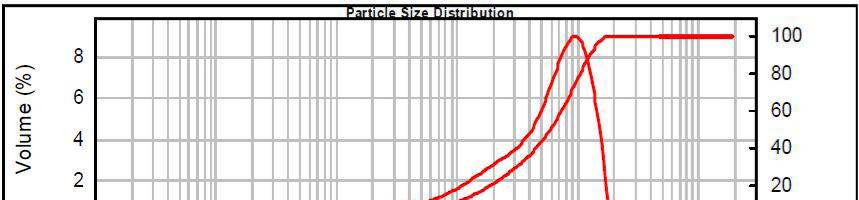
26 APPENDIX 3/2 TESTING OF THE SAMPLES 24 Particle size To test the particle size of samples one sample of each sample type was tested using laser diffraction (Malvern). In Figure 1 is showing the distribution of particle size for the samples B1 and K1. For peat sample B1 the mean size of particles was 39.7 µm and 99.8 % of the particles were smaller than 550 µm. For coal sample K1 the mean size of particles was 60.5 µm and 100 % of the particles were smaller than 212 µm. For the both sample material the requirement of particle size given in the international standards was fulfilled [5, 6]. a) The particle size distribution of peat B1. b) The particle size distribution of coal K1. Figure 1. The particle size distribution of the fuel samples.
27 COMMENTS SENT BY THE PARTICIPANTS 25 APPENDIX 4/1 Lab Comment to the samples / PT Action/Proftest 13, 16 The samples were delivered crosswise between the two local offices of the participants. 23 The participants ordered both testing samples, but only the sample B1 (peat) delivered. The local offices changed their samples themselves. The provider will be more carefully in the packing of samples. The sample B1 was unfortunately unpacked and the participant did not want the sample later. The missed sample was not charged. The provider will be more carefully in the packing of samples. 33, 39 The samples were delayed. The local, national, post services had difficulties to deliver the packets to the participants. 42 The samples were delayed due to the incomplete address. The samples were posted to the address which was informed on the registration form to the provider. Lab Comment to the results Action/Proftest 26 The results of q-v,gr,d and q- p,net,d for the samples were reported erroneously. The results were not corrected into the final data. They were outliers in the statistical treatment, and so they have not affected the performance evaluation. The laboratory informed new results for the samples after receiving the preliminary results: B1: q-v,gr,d and q-p,net,d J/g, K1: q-v,gr,d and q-p,net,d J/g 33, 44 The results of calorific values were reported in MJ/g instead of the requested J/g. 46 After sending the preliminary results the participants informed that they were reported M ad in the sample K1 incorrectly. The right results were: 1.82 % and 1.74 % 47 The laboratory has not reported the results in dry weight basis (as analysed). The laboratory informed new results for the samples after receiving the preliminary results: K1: q-v,gr,d and q-p,net,d J/g, Ash% 10.9, S% 0.32 If the results should have been reported rightly they should have been satisfactory. The participant can re-calculate z scores according to the guide for participating laboratories in Proftest proficiency testing schemes ( The units were corrected by the provider. However, in the future proficiency tests the unit corrections will be not done. The results were handled as outliers in the statistical treatment. The results were handled as outliers in the statistical treatment. If the results should have been reported rightly they should have been satisfactory. The participant can re-calculate z scores according to the guide for participating laboratories in Proftest proficiency testing schemes (
28 APPENDIX 4/2 COMMENTS TO THE PARTICIPANTS 26 Laboratory Comments on results 28 The laboratory provided results several times; new results and corrections to the older ones. The provider recommended that the results will be provided at once and only minor corrections later, if needed. 30, 38, 58 Laboratories reported only one result, though replicate results were requested. These results were not included in the calculation of assigned values. 16, 31, 28 Laboratories reported four parallel results, though replicate results were requested. The two first results were included in the final database. 6, 25, 26, 36, The laboratories reported the measurement uncertainties as ± J/g instead of UC %. The values 37, 51, 52, 54 were corrected by the provider. The provider did not assure that all erroneously reported values have been corrected. No comments to the uncertainty corrections were given from the participants after the preliminary results. The provider strongly recommended that the participants are more carefully to report the uncertainty correctly. The performance evaluation using zeta scores, which based on the measurement uncertainties, is unsure due to the errors in the result reporting by the participants. - After receiving the preliminary results several participants informed their missing data in the z and zeta score comparison (Appendix 6 in the preliminary results). These participants were not reported their measurement uncertainties with the results. As the zeta score is based on the uncertainties the data of non-reported participants were not reported in this Annex. The provider will more clearly describe the zeta score reporting in the covering letter of preliminary results. - Fewer errors than the previous test were found in the wrongly reported units, which is a good feedback. In the future wrong unit will be not corrected by the provider, unless a total amount of results is too low for the statistical calculations.
29 ANALYTICAL METHODS 27 APPENDIX 5.1/1 Analyte Code Method q-v,gr,d q-p,net,d 1 CEN/TS ISO DIN ASTM D Other Ash 1 CEN/TS ISO DIN ASTM D Other C, H, N 1 CEN/TS ISO/TS ASTM D Other S 1 CEN/TS ISO ASTM D Other M ad 1 CEN/TS ISO DIN ASTM D Other
30 APPENDIX 5.1/2 28 ANALYTICAL METHODS Measurements: Measurement of Sample B1 gross calorific value Date of analysis in 20.9, 22.9, 21.9, 23.9, 28.9, 30.9, 1.10, , 6.10, 7.10, , , , Sample amount Mainly g used < 0.5 g used: 0.3 g (lab 20), 0.2 g (lab 30) Drying of sample Air dried: lab 7, 8, 9, 12, 15, 16, 21, 22, 24, 26, 31, 37, 57 At 105 o C dried: lab 4, 14, 27, 34, 38 Air dried & at 105 o C dried: lab 58 No drying: lab 5, 20, 29, 30, 40, 43, 60 Equipment (manufacturer, volume of bomb and volume of added water) 14 labs: IKA (model C2000, C5000, C5003 or C7000) with different bomb volumes ( ml) and with the added water of 1 or 5 ml 3 labs: PARR (model 1261, 1281, 6300 or 6400) with bomb volume 250 ml (or not given) and with the added water of 0 ml (lab 14, 16) 8 labs: LECO (model AC 300 or 350) with bomb volume ml and with the added water of 1 ml or 5 ml Sample K1 29.9/4.10, 27.9, 28.9, 22.9, 24.9, 26.9, 27.9, 29.9, 30.9, 1.10, , 4.10, 5.10, , , , , , Mainly g used < 0.5 g used: 0.3 g (lab 20), g (lab 46) Air dried: lab 2, 3, 4, 11, 12, 13, 15, 21, 22, 23, 24, 25, 28, 31, 36, 37, 42, 44, 45, 47, 48, 52, 57 At 105 o C dried: lab 13, 29, 34, 38, 39, 46, 58 Air dried & at 105 o C dried: lab 33, 49, 52 No drying: lab 5, 6, 20, 32, 40, 43, 49, 54, 56, labs: IKA (model 2000, 5000, 5003 or 7000) with different bomb volumes ( ml) and with the added water of 1 or 5 ml 10 labs: LECO (model AC 300, 350 or 500) with bomb volume ml (2000 ml lab 6) and with added water of 1 10 ml 10 labs: PARR (model 1261, 1281,6200, 6300 or 6400) with bomb volume ml (or not given) and with the added water of 1 ml Sanio Gallenkamp with the bomb volume 250 ml and added water 1 ml (lab 3), 1 lab: Julius Peters with the bomb volume 301 ml and with the added water 10 ml 1 lab: Lagent MS with the bomb volume 300 ml and with the added water 1 ml 1 lab: Precizia KL 10 with the bomb volume 350 ml and with the added water 5 ml
31 ANALYTICAL METHODS Measurements: Measurement of Sample B1 gross calorific value Calibration Benzoeacid 4 labs: PARR, 26454, or J/g 6 labs: BAS-BCS, 26439,7 J/g 3 labs: IKA, 26456, J/g 6 labs: ALPHA, 26564, or J/g 1 labs: NIST 2 lab: Fluka, J/g 4 lab: LECO, 26451, 26440, J/g 1 lab: Federal state unitary enterprise, J/g 1 lab: Sigma-Aldrich 7 labs: as weighed 9 labs: in air 2 labs: in vacuum 29 APPENDIX 5.1/3 Sample K1 Benzoeacid 10 labs: PARR, or J/g 8 labs: IKA, 26460, or J/g 8 labs: BAS-BCS, J/g 5 labs: ALPHA, 26434, 26454, or J/g 3 labs: NIST, J/g 4 lab: LECO, 26451, J/g 1 lab: Fluka, J/g 1 lab: Sigma-Aldrich 1 lab: Riedel, J/g 1 lab: BHD, J/g 1 lab: Federal state unitary enterprise, J/g 9 labs: as weighed 19 labs: in air (lab 3, 11, 13, 15, 24, 28, 33, 34, 37, 38, 40, 41, 42, 45, 46, 48, 58, 60) 7 labs: in vacuum Correction of the certified value 1 17 labs: no 9 labs: yes (lab 4, 5, 8, 16, 21, 22, 58, 59) 1 Correction of the certified value 1 32 labs: no 12 labs: yes (lab 4, 5, 12, 21, 22, 36, 48, 49, 58) 1 1 Correction the value given in the certificate lab 5: corrected value J/g (5 ml water) lab 8: mean has been calculated from the control sample charts (x-charts) lab 1, 12, 59: volume, temperature, pressure lab 16: corrected value J/g lab 21: It has been used as an input reference value for the calorimeter lab 36: wire and N in air lab 4, 22, 48, 49, 58: with factor that is calculated according to the certificate
32 APPENDIX 5.1/4 30 ANALYTICAL METHODS Calculations: Gross calorific Sample B1 value Correction taken wire, ignition, acid, moisture (lab 60) into account in wire, ignition, S, acid (lab 4) calculations moisture (lab 24) wire, moisture (lab 9) analysis moisture (lab 7) wire, S, acid (lab 30, 57) wire, S, acid, moisture (lab 11, 16, 20, 22, 26, 27, 59) wire, S and N (lab 15) N, S, moisture (lab 31) cotton, wire, moisture, (lab 8) wire, S, moisture (lab 2, 29) wire, moisture, N, S (lab 5) not in detail (lab 34, 37, 43) fixed acid correction (lab 14) wire, cotton, S, combustion aid (dodecane) (lab 40) Sample K1 Net calorific value Sample B1 Sample K1 Correction taken into account in calculations N+O, H/measured (lab 1, 4, 40) H/fixed (lab 7, 8 (5.60%)) H/measured (lab 22, 30) N+O (40 lab 24), H (6, lab 24) N+O, H/calculated (lab 27 ) [N+O]=100 % -[ash-c-h-s] (lab 21) not in detail (lab 34, 37, 43) S, H measured (lab 9) N+O, H (lab 29, 60) only H (lab 12, 3, 59) N, H fixed (1.22 MJ/kg) N-5.6% (fixed)+n%=35% (lab 16) S, N, acid, wire, moisture (lab 26) moisture, acid, ash, H, N/measured (lab 57) wire, ignition, acid, moisture (lab 60) wire, ignition, S, acid, moisture (lab 4, 5, 41) wire, ignition, S, moisture, acid (lab 2) not in detail (lab 11, 34, 37, 43) S, N, moisture (lab 24, 31) wire, acid (lab 22) wire, S (lab 48) wire (lab 53) wire, S, acid (lab 33, 46, 47, 52, 56, 57) wire, N (lab 36) wire, S, acid, moisture (lab 12, 20, 22, 28, 32, 54) correction 156 J/g (lab 38) wire, S, N (lab 15) wire, acid, moisture (lab 13) wire, N, S, moisture (lab 5, 29) wire, S, moisture (lab 21, 25, 42) wire, cotton, moisture (lab 3, 44) wire, cotton, S, combustion aid (dodecane) (lab 40) wire, paper, S, acid (lab 45) moisture (lab 49) wire, moisture, paper (lab 50) DIN ( 212 J/% for H, 24.4 J/% for H 2 O (lab 2) N+O, H/measured (lab 1, 4, 22, 40) N+O, H/calculated (lab 41) not in detail (lab 5, 6, 11, 34, 37, 43 and 38) H/measured (lab 3, 50, 12) H/calculated (lab 25, 46, 53) H/calculated from volatiles (lab 13) N+O]=100 % -[ash-c-h-s] (lab 21) only H (lab 12, 6:lab 24, lab 31) N+O, H (lab 29, 60) %H 2 O=8.94*H(%), heat of vaporization of water (25ºC,p) J/mol (lab 32) N (59 kj/mol), S (55.45 J/mol), H (lab 36) Fixed H, ash, moisture (lab 42) H, N (lab 45) H, O, moisture (lab 48) H 5.8%, O 32%, N 1.5% use in calculation ISO1928:1995, annex E3.2 (lab 49) N+O, H ISO 1925 (lab 52) H, O (lab 56) moisture, acid, ash, H, N/measured (lab 57)
33 ANALYTICAL METHODS Measurements: Measurement of Sample B1 C, H and N Sample amount 31 APPENDIX 5.1/5 Sample K mg (depending on an equipment), 1 g (N), 796 mg mg (depending on an equipment), 1 g (N) or > 1g, 919 mg Equipment (manufacturer) 3 labs: VarioMAX CHN 2 labs: Vario EL 6 labs: LECO CHN or CS labs: ELTRA CHS lab: CE Instruments 1 lab: EURO EA 1 lab: Skalar Primacs SLC (only C) 1 lab: Tru Spe CHN 1 lab: Jena multi EA 2000 (only C) 1 lab: Dionex ICSS2000 (only N) 1 lab: Martinek analyzer (C, H) 1 lab: Pramas-Vagner (N) 1 lab: Dennstedt oven (C, N) 3 labs: VarioMAX CHN 2 labs: Vario EL 10 labs: LECO CHN, CHN/S, TC, CR or CS 3 labs: ELTRA CHS 4 lab: Vario MACRO 1 lab. Bichi, KjellFix 1 lab: EURO EA 1 lab: CE Instruments 1 lab: Skalar Primacs SLC (only C) 1 lab: Martinek analyzer (C, H) 1 lab: Pramas-Vagner (N) 1 lab: Dennstedt oven (C, N) 1 lab: TruSpec CHN (N) 1 lab: Thermo Finning Flash lab: Elemental analyzer Flash EA 1112, Thermo C, H calculated (lab 47) Measurement of S Sample B1 Sample K1 Sample amount Mainly g (depending on an equipment), 6 g (lab 57) Eschka: 1 g (lab 31) Mainly g (depending on an equipment), 1 mg (lab 3), 1 g (lab 24, 3), 70 mg (lab 52), 6 g (lab 57) Equipment (manufacturer) 2 labs: ELTRA CS 8 labs: LECO SC or S 1 lab: IKA AOD 1 lab: EURO EA 1 lab: LECO CHNS 1 lab: Oxidation + ion chromatorgraphy (lab 21) 1 lab: Iris Interip thermo elementar (lab 9) 1 lab: Jena multi EA lab: Mitsubishi TS-100V 1 lab: Esche mixture 1 lab: EDXRF (lab 57) Eschka method: 1 g (lab 49) 6 labs: ELTRA CS or CHS 14 labs: LECO, SC, S or CHN/S 1 labs: Vario EL 1 lab: EURO EA 1 lab: LECO CHNS 1 lab: Oxidation + ion chromatorgraphy (lab 21) 1 lab: Muffle furnace F6000, Vamstead/Thermolyne Corporation 1 lab: S.I.E. 1 lab: Esche mixture 1 lab: Parr ion chromatoraphy 1 lab: Elemental analyzer Flash EA FDP 1112, Thermo 1 lab: EDXRF (lab 57) 1 lab: carbolite tube furnace
34 APPENDIX 5.1/6 ANALYTICAL METHODS Measurements: Measurement of Sample B1 ash content 32 Sample K1 Sample amount g (mainly 1 g) g (mainly 1 g) Measurement and temperature Measurement of moisture Measurement 19 labs: Gravimetric 5 labs: TGA (lab 15, 21, 37) 1 lab: Tgl (lab 29) Temperature 14 labs: 550 o C 1 lab: 525 o C (lab 9) 7 labs: 815 o C (lab 8, 14, 16, 38, 57, 60) 1 lab: 925 o C (lab 21) 1 lab: 950 o C (lab 26) 1 lab: 725 o C (lab 43) 1 lab: 740 o C (lab 58, no method) Sample B1 17 an air (lab 4, 5, 7, 9, 12, 15, 16, 20, 21, 22, 24, 31, 34, 38, 57, 58 7 lab an N 2 atmosphere (26, 27, 29, 37, 40, 43, 60) Measurement 35 labs: Gravimetric 2 labs: TGI (lab 3, 29) 5 lab: TGA (lab 15, 21, 36, 45) 1 lab. MAC-400 (lab 37) Temperature 30 labs: 815 o C 4 lab: 750 o C (lab 6, 28, 32, 54) 2 lab: 550 o C (lab 20, 49) 1 lab: 925 o C (lab 21) 1 lab: 960 o C (lab 36) 1 lab: 820 o C (lab 42) 1 lab: 725 o C (lab 43) 1 lab: 800 o C (lab 46) 1 lab: 740 o C (lab 58, no method) Sample K1 Calculations: Emission factor Sample B1 Sample K1 (EF) 1 Equation according to the decision 2007/589/EC 9 labs: According to EC decision 1 1 lab: national (lab 40) 1 lab (lab 21): based on the equation: 1000*3.664*(C/100)*(1- (50.8/100)/Q(p,net,50,8 %) 25 an air (lab 3, 4, 13, 15, 20, 21, 22, 23, 24, 28, 31, 33, 34, 38, 39, 41, 42, 44, 45, 46, 48, 49, 50, 52, 53, 57, 58) 14 lab an N 2 atmosphere (lab 2, 4, 11, 12, 25, 29, 32, 36, 37, 40, 43, 47, 54, 56, 60) 15 labs: According to EC decision 1 labs: national (lab 40) 1 lab (lab 29): based on the equation: 1000*3.664*(C/100)*(1- (8.27/100)/Q(p,net,8.27 %) 1 lab: EU. D. 2003/87/CE 1 lab: F=C(tC/t com )*3.664/Pci (lab 32) 1 In the sample letter the provider gave a possibility to the participants to calculate the EF-value using the procedure presented in the EC directive and using the total moisture content as received presented in the letter. Later has been obtained, that in the EC directives has not been given the detailed equation for calculation of EFvalues. However, a written description has been given. Due to this some national guides for the equation of EFvalue calculation has been produced. In Finland the Energy Market Authority has made the guideline for the calculation of emission factor for fossile fuels as follows ( EF = (C/100) (1 M ar /100)/Q net,ar, where EF emission factor, g CO 2 /MJ C carbon content as dry, % M ar total moisture as received, % Q net,ar net calorific value as received, MJ/kg
35 33 APPENDIX 5.2 SIGNIFICANT DIFFERENCES IN THE RESULTS REPORTED USING DIF- FERENT STANDARD METHODS In the statistical comparison of the methods has included the data, in which the number of the results was 3. Analyte Sample Method X sd n Significant difference S K1 2. ISO X: meth ASTM D M ad K1 2. ISO X: meth 2-3, DIN ASTM D where, X: the mean value sd: the standard deviation n: the number of the result
36 LIITE APPENDIX 5.3 / 1 34 LIITE 5.3. RESULTS GROUPED ACCORDING TO THE METHODS APPENDIX 5.3.Method code - see appendix 5.1 Analyytti (Analyte) Ash,d Näyte (Sample) B1 w% 8,8 8,6 8,4 8,2 8 7,8 7,6 7,4 7,2 7 6,8 6,6 Meth 1 Meth 2 Meth 3 Meth 5 Analyytti (Analyte) Ash,d Näyte (Sample) K1 w% 11,5 11,4 11,3 11,2 11, ,9 10,8 10,7 10,6 10,5 10,4 10,3 Meth 1 Meth 2 Meth 3 Meth 4 Meth 5 Analyytti (Analyte) C,d Näyte (Sample) B w% Meth 1 Meth 2 Meth 3 Meth 4 Meth 5 SYKE - Interlaboratory comparison test 5/2010
37 35 LIITE APPENDIX 5.3 / 2 Analyytti (Analyte) C,d Näyte (Sample) K w% Meth 1 Meth 2 Meth 3 Meth 4 Meth 5 Analyytti (Analyte) H,d Näyte (Sample) B1 6,6 6,4 6,2 6 5,8 w% 5,6 5,4 5,2 5 4,8 Meth 1 Meth 3 Meth 4 Meth 5 Analyytti (Analyte) H,d Näyte (Sample) K1 5,4 5,2 5 4,8 w% 4,6 4,4 4,2 4 3,8 Meth 1 Meth 2 Meth 3 Meth 4 Meth 5 SYKE - Interlaboratory comparison test 5/2010
38 LIITE APPENDIX 5.3 / 3 36 Analyytti (Analyte) Mad,d Näyte (Sample) B1 w% 4 3,8 3,6 3,4 3,2 3 2,8 2,6 2,4 2,2 2 1,8 1,6 1,4 Meth 1 Meth 3 Meth 4 Meth 5 Analyytti (Analyte) Mad,d Näyte (Sample) K1 5 4,5 4 w% 3,5 3 2,5 2 Meth 1 Meth 2 Meth 3 Meth 4 Meth 5 Analyytti (Analyte) N,d Näyte (Sample) B1 w% 2,2 2,1 2 1,9 1,8 1,7 1,6 1,5 1,4 1,3 1,2 1,1 Meth 1 Meth 3 Meth 4 Meth 5 SYKE - Interlaboratory comparison test 5/2010
39 37 LIITE APPENDIX 5.3 / 4 Analyytti (Analyte) N,d Näyte (Sample) K1 2,8 2,6 2,4 w% 2,2 2 1,8 1,6 1,4 Meth 1 Meth 2 Meth 3 Meth 4 Meth 5 Analyytti (Analyte) q-p,net,d Näyte (Sample) B J/g Meth 1 Meth 2 Meth 3 Meth 4 Meth 5 Analyytti (Analyte) q-p,net,d Näyte (Sample) K J/g Meth 1 Meth 2 Meth 3 Meth 4 Meth 5 Meth? SYKE - Interlaboratory comparison test 5/2010
40 LIITE APPENDIX 5.3 / 5 38 Analyytti (Analyte) q-v,gr,d Näyte (Sample) B1 J/g Meth 1 Meth 2 Meth 3 Meth 4 Meth 5 Analyytti (Analyte) q-v,gr,d Näyte (Sample) K1 J/g Meth 1 Meth 2 Meth 3 Meth 4 Meth 5 Analyytti (Analyte) S,d Näyte (Sample) B1 0,34 0,32 0,3 0,28 w% 0,26 0,24 0,22 0,2 0,18 0,16 Meth 1 Meth 2 Meth 3 Meth 4 Meth 5 SYKE - Interlaboratory comparison test 5/2010
41 39 LIITE APPENDIX 5.3 / 6 Analyytti (Analyte) S,d Näyte (Sample) K1 w% 0,42 0,4 0,38 0,36 0,34 0,32 0,3 0,28 0,26 0,24 0,22 0,2 Meth 1 Meth 2 Meth 3 Meth 4 Meth 5 SYKE - Interlaboratory comparison test 5/2010
42 APPENDIX 6 40 EVALUATION OF THE ASSIGNED VALUES AND THEIR UNCERTAINTIES Analyte Sample Unit Assigned value Estimation of assigned value Uncertainty (U = 2*u) 1), % u/s p 2) Ash B1 w% 7.7 Robust mean K1 w% 10.9 Robust mean C B1 w% 53.4 Robust mean K1 w% 73.3 Robust mean H B1 w% 5.6 Robust mean K1 w% 4.6 Robust mean EF B1 tco 2 /TJ 106 Robust mean K1 tco 2 /TJ 93.8 Robust mean M B1 w% 7.68 Robust mean K1 w% 3.17 Robust mean N B1 w% 1.62 Robust mean K1 w% 2.14 Robust mean q-p,net,d B1 J/g Robust mean K1 J/g Robust mean q-v,gr,d B1 J/g Robust mean K1 J/g Robust mean S B1 w% 0.25 Robust mean K1 w% 0.31 Robust mean The expanded uncertainty of the assigned value 1) was estimated according to the equation [3]: U % AV n s rob where, U% = the expanded uncertainty of the assigned value n = the number of the results s rob = the robust standard deviation AV= the assigned value To test the reliability of uncertainty of assigned value the ratio, u/s p 2), was calculated [4], where: s p = the total standard deviation for proficiency assessment divided by 2 u = the standard uncertainty of the assigned value If u/s p 0.3 the assigned value is reliable and the z scores are qualified.
43 TERMS IN THE RESULT TABLES 41 APPENDIX 7 Sample z-graphics z score The code of the sample z score - the graphical presentation calculated as follows: z = (x i - X)/s p, where x i = the result of the individual laboratory X = the assigned value s p = the target value of the standard deviation for proficiency assessment. zeta score zeta= ( xi X )/ 2 u lab 2 u c, u lab = the standard uncertainty of the participant's result u c = the standard uncertainty of the assigned value Outl test OK yes - the result passed the outlier test H = Hampel test (a test for the mean value) Assigned value the reference value Assigned value 2*U C the expanded uncertainty of the assigned value 2* Targ SD %, the target value of total standard deviation for proficiency assessment (s p ) at Targ 2SD% 95 % confidence level Lab s result the result reported by the participant (the mean value of the replicates) Md. Median Mean Mean Robust mean Robust mean SD Standard deviation SD% Standard deviation, % SD %rob Robust standard deviation, % Passed The results passed the outlier test Missing i.e. < DL Num of labs the total number of the participants Nr the number of the result in the diagram (Appendix 11) Summary on the z scores S satisfactory ( -2 z 2) Q questionable ( 2< z < 3), positive error, the result deviates more than 2 * s p from the assigned value q questionable ( -3 > z< -2), negative error, the result deviates more than 2 * s p from the assigned value U unsatisfactory (z 3), positive error, the result deviates more than 3 * s p from the assigned value u unsatisfactory (z -3), negative error, the result deviates more than 3 * s p from the assigned value Robust analysis The items of data is sorted into increasing order, x 1, x 2, x i,,x p. Initial values for x * and s * are calculated as: X * = median of x i (i = 1, 2, p) s * = median of x i x* (i = 1, 2, p) For each x i (i = 1, 2, p) is calculated: x * i = x * - if x i < x * - x * i = x * + if x i > x * + x * i = x i otherwise The new values of x * and s * are calculated from: * x xi / p s * ( x i x ) 2 /( p 1) The robust estimates x * and s * can be derived by an iterative calculation, i.e. by updating the values of x * and s * several times, until the process convergences. Ref: Statistical methods for use in proficiency testing by inter laboratory comparisons, Annex C [3].
44 LIITE 8 / 1 42 APPENDIX LIITE 8. RESULTS OF EACH PARTICIPANT APPENDIX 8. Analyte Unit Sample z-graphics Z- value Outl Assigned test OK value 2* Targ SD% Lab's result Md. Mean SD SD% Passed Outl. failed Missing Num of labs Laboratory 1 Ash,d 0,649 yes 7,7 6 7,85 7,7 7,696 0,1756 2, ,514 yes 10,9 2,5 10,83 10,91 10,88 0,1371 1, C,d 1,124 yes 53,4 3 54,3 53,61 53,41 0,7942 1, ,218 yes 73,3 2,5 73,1 73,25 73,22 0,9928 1, H,d 0,355 yes 5,63 7 5,7 5,675 5,629 0,1487 2, ,242 yes 4,6 7 4,4 4,57 4,596 0,209 4, Mad,d yes 2,88 3,8 2,87 2,852 0, , yes 3,52 3,5 3,53 3,507 0,301 8, N,d 0,658 yes 1, ,7 1,601 1,621 0, , ,374 yes 2, ,2 2,17 2,137 0,1439 6, q-p,net,d J/g B1 0,831 yes , ,3 0, ,190 yes , ,3 0, q-v,gr,d J/g B1 1,064 yes , ,4 0, ,644 yes ,9 0, S,d 0,533 yes 0, ,26 0,248 0,2504 0,0173 6, ,430 yes 0, ,32 0,31 0,3068 0,022 7, Laboratory 2 Ash,d 0,220 yes 10,9 2,5 10,93 10,91 10,88 0,1371 1, C,d 0,005 yes 73,3 2,5 73,31 73,25 73,22 0,9928 1, H,d -0,683 yes 4,6 7 4,49 4,57 4,596 0,209 4, Mad,d yes 3,52 4,025 3,53 3,507 0,301 8, q-p,net,d 0,491 yes , ,3 0, q-v,gr,d 0,292 yes ,9 0, S,d -0,430 yes 0, ,3 0,31 0,3068 0,022 7, Laboratory 3 Ash,d 0,991 yes 10,9 2,5 11,04 10,91 10,88 0,1371 1, Mad,d yes 3,52 3,93 3,53 3,507 0,301 8, q-p,net,d 1,602 yes , ,3 0, q-v,gr,d 2,354 yes ,9 0, S,d -0,237 yes 0, ,3045 0,31 0,3068 0,022 7, Laboratory Ash,d C,d EF H,d Mad,d N,d q-p,net,d q-v,gr,d S,d Laboratory Ash,d Mad,d q-v,gr,d S,d 4 1,277 yes 7,7 6 7,995 7,7 7,696 0,1756 2, ,514 yes 10,9 2,5 10,97 10,91 10,88 0,1371 1, ,568 yes 53,4 3 52,95 53,61 53,41 0,7942 1, ,079 yes 73,3 2,5 71,4 73,25 73,22 0,9928 1, t B1-0,542 yes ,8 106,1 105,9 2, t K1-0,453 yes 93,8 4 92,95 93,91 93,78 1,6 1, ,414 yes 5,63 7 5,712 5,675 5,629 0,1487 2, ,888 yes 4,6 7 4,743 4,57 4,596 0,209 4, yes 2,88 2,235 2,87 2,852 0, , yes 3,52 2,735 3,53 3,507 0,301 8, ,280 yes 1, ,586 1,601 1,621 0, , ,819 yes 2, ,008 2,17 2,137 0,1439 6, J/g B1-0,179 yes , ,3 0, ,853 yes , ,3 0, J/g B1-0,112 yes , ,4 0, ,341 yes ,9 0, ,280 yes 0, ,274 0,248 0,2504 0,0173 6, ,129 yes 0, ,313 0,31 0,3068 0,022 7, ,649 yes 7,7 6 7,85 7,7 7,696 0,1756 2, ,110 yes 10,9 2,5 10,91 10,91 10,88 0,1371 1, yes 2,88 3,155 2,87 2,852 0, , yes 3,52 2,79 3,53 3,507 0,301 8, J/g B1-0,063 yes , ,4 0, ,915 yes ,9 0, ,693 yes 0, ,237 0,248 0,2504 0,0173 6, ,086 yes 0, ,308 0,31 0,3068 0,022 7, Outlier test failed: C - Cohcran, G1 - Grubbs(1-outlier algorithm), G2 - Grubbs(2-outliers algorithm), H - Hampel, M - manual SYKE - Interlaboratory comparison test 5/2010
45 43 LIITE APPENDIX 8 / 2 Analyte Unit Sample z-graphics Z- value Outl Assigned test OK value 2* Targ SD% Lab's result Md. Mean SD SD% Passed Outl. failed Missing Num of labs Laboratory 6 Ash,d 0,330 yes 10,9 2,5 10,95 10,91 10,88 0,1371 1, C,d -0,224 yes 73,3 2,5 73,09 73,25 73,22 0,9928 1, H,d 0,932 yes 4,6 7 4,75 4,57 4,596 0,209 4, Mad,d yes 3,52 3,795 3,53 3,507 0,301 8, N,d 0,561 yes 2, ,23 2,17 2,137 0,1439 6, q-p,net,d -0,494 yes , ,3 0, q-v,gr,d -0,010 yes ,9 0, S,d 0,645 yes 0, ,325 0,31 0,3068 0,022 7, Laboratory 7 Ash,d 0,411 yes 7,7 6 7,795 7,7 7,696 0,1756 2, Mad,d yes 2,88 2,57 2,87 2,852 0, , q-p,net,d J/g B1-0,274 yes , ,3 0, q-v,gr,d J/g B1-0,254 yes , ,4 0, Laboratory 8 Ash,d -0,433 yes 7,7 6 7,6 7,7 7,696 0,1756 2, Mad,d yes 2,88 2,31 2,87 2,852 0, , q-p,net,d J/g B1-0,445 yes , ,3 0, q-v,gr,d J/g B1-0,540 yes , ,4 0, Laboratory 9 Ash,d -0,390 yes 7,7 6 7,61 7,7 7,696 0,1756 2, C,d -0,843 yes 53,4 3 52,72 53,61 53,41 0,7942 1, H,d 0,553 yes 5,63 7 5,739 5,675 5,629 0,1487 2, Mad,d yes 2,88 2,045 2,87 2,852 0, , N,d 0,156 yes 1, ,639 1,601 1,621 0, , q-p,net,d J/g B1-0,668 yes , ,3 0, q-v,gr,d J/g B1-0,659 yes , ,4 0, S,d -0,080 yes 0, ,2485 0,248 0,2504 0,0173 6, Laboratory 10 Ash,d 0,514 yes 10,9 2,5 10,97 10,91 10,88 0,1371 1, C,d 2,210 yes 73,3 2,5 75,33 73,25 73,22 0,9928 1, Mad,d yes 3,52 3,575 3,53 3,507 0,301 8, q-p,net,d 0,441 yes , ,3 0, q-v,gr,d 0,466 yes ,9 0, S,d 0,430 yes 0, ,32 0,31 0,3068 0,022 7, Laboratory 11 Ash,d 0,147 yes 10,9 2,5 10,92 10,91 10,88 0,1371 1, C,d -0,971 yes 73,3 2,5 72,41 73,25 73,22 0,9928 1, H,d 2,950 yes 4,6 7 5,075 4,57 4,596 0,209 4, Mad,d yes 3,52 3,59 3,53 3,507 0,301 8, N,d -1,340 yes 2, ,925 2,17 2,137 0,1439 6, q-p,net,d -0,171 yes , ,3 0, q-v,gr,d -0,335 yes ,9 0, S,d 0,000 yes 0, ,31 0,31 0,3068 0,022 7, Laboratory 12 Ash,d 1,017 yes 7,7 6 7,935 7,7 7,696 0,1756 2, ,917 yes 10,9 2,5 11,03 10,91 10,88 0,1371 1, C,d 0,568 yes 53,4 3 53,86 53,61 53,41 0,7942 1, ,742 yes 73,3 2,5 73,98 73,25 73,22 0,9928 1, EF t B1 0,283 yes ,6 106,1 105,9 2, t K1 0,426 yes 93,8 4 94,6 93,91 93,78 1,6 1, H,d 0,099 yes 5,63 7 5,649 5,675 5,629 0,1487 2, ,867 yes 4,6 7 4,46 4,57 4,596 0,209 4, Mad,d yes 2,88 3,525 2,87 2,852 0, , yes 3,52 3,774 3,53 3,507 0,301 8, N,d -0,963 yes 1, ,503 1,601 1,621 0, , ,779 yes 2, ,015 2,17 2,137 0,1439 6, q-p,net,d J/g B1-0,065 yes , ,3 0, ,766 yes , ,3 0, q-v,gr,d 0,721 yes ,9 0, S,d 0,587 yes 0, ,261 0,248 0,2504 0,0173 6, ,150 yes 0, ,3135 0,31 0,3068 0,022 7, Outlier test failed: C - Cohcran, G1 - Grubbs(1-outlier algorithm), G2 - Grubbs(2-outliers algorithm), H - Hampel, M - manual SYKE - Interlaboratory comparison test 5/2010
46 LIITE 8 / 3 44 APPENDIX Analyte Unit Sample z-graphics Z- value Outl Assigned test OK value 2* Targ SD% Lab's result Md. Mean SD SD% Passed Outl. failed Missing Num of labs Laboratory 13 Ash,d -2,349 yes 10,9 2,5 10,58 10,91 10,88 0,1371 1, Mad,d yes 3,52 3,575 3,53 3,507 0,301 8, q-p,net,d 0,214 yes , ,3 0, q-v,gr,d 0,268 yes ,9 0, S,d -1,699 yes 0, ,2705 0,31 0,3068 0,022 7, Laboratory 14 Ash,d -0,173 yes 7,7 6 7,66 7,7 7,696 0,1756 2, Mad,d yes 2,88 2,265 2,87 2,852 0, , q-p,net,d J/g B1 0,234 yes , ,3 0, q-v,gr,d J/g B1 0,283 yes , ,4 0, Laboratory 15 Ash,d -1,342 yes 7,7 6 7,39 7,7 7,696 0,1756 2, ,220 yes 10,9 2,5 10,87 10,91 10,88 0,1371 1, Mad,d C 2,88 2,655 2,87 2,852 0, , yes 3,52 3,33 3,53 3,507 0,301 8, q-v,gr,d J/g B1-5,288 H , ,4 0, ,190 H ,9 0, S,d -1,413 yes 0, ,2235 0,248 0,2504 0,0173 6, ,161 yes 0, ,283 0,31 0,3068 0,022 7, Laboratory 16 Ash,d 0,368 yes 7,7 6 7,785 7,7 7,696 0,1756 2, Mad,d yes 2,88 3,4 2,87 2,852 0, , q-p,net,d J/g B1-0,432 yes , ,3 0, q-v,gr,d J/g B1-0,550 yes , ,4 0, Laboratory 17 Ash,d -2,165 yes 10,9 2,5 10,61 10,91 10,88 0,1371 1, Mad,d yes 3,52 3,635 3,53 3,507 0,301 8, q-p,net,d -1,768 yes , ,3 0, q-v,gr,d -0,369 yes ,9 0, Laboratory 18 Ash,d 0,183 yes 10,9 2,5 10,93 10,91 10,88 0,1371 1, C,d -0,126 yes 73,3 2,5 73,19 73,25 73,22 0,9928 1, EF t K1 0,187 yes 93,8 4 94,15 93,91 93,78 1,6 1, H,d -0,472 yes 4,6 7 4,524 4,57 4,596 0,209 4, Mad,d yes 3,52 3,463 3,53 3,507 0,301 8, N,d -0,327 yes 2, ,088 2,17 2,137 0,1439 6, q-p,net,d -0,134 yes , ,3 0, q-v,gr,d -0,181 yes ,9 0, S,d -0,602 yes 0, ,296 0,31 0,3068 0,022 7, Laboratory 19 C,d 0,164 yes 73,3 2,5 73,45 73,25 73,22 0,9928 1, H,d 1,118 yes 4,6 7 4,78 4,57 4,596 0,209 4, Mad,d yes 3,52 3,415 3,53 3,507 0,301 8, N,d 1,651 yes 2, ,405 2,17 2,137 0,1439 6, S,d 0,237 yes 0, ,3155 0,31 0,3068 0,022 7, Laboratory 20 Ash,d 3,355 H 7,7 6 8,475 7,7 7,696 0,1756 2, ,734 yes 10,9 2,5 10,8 10,91 10,88 0,1371 1, C,d 6,055 H 53,4 3 58,25 53,61 53,41 0,7942 1, ,040 H 73,3 2,5 79,75 73,25 73,22 0,9928 1, Mad,d yes 2,88 3,1 2,87 2,852 0, , yes 3,52 3,52 3,53 3,507 0,301 8, q-v,gr,d J/g B1-2,405 yes , ,4 0, ,469 yes ,9 0, S,d -0,613 yes 0, ,2385 0,248 0,2504 0,0173 6, ,172 yes 0, ,306 0,31 0,3068 0,022 7, Outlier test failed: C - Cohcran, G1 - Grubbs(1-outlier algorithm), G2 - Grubbs(2-outliers algorithm), H - Hampel, M - manual SYKE - Interlaboratory comparison test 5/2010
47 45 LIITE APPENDIX 8 / 4 Analyte Unit Sample z-graphics Z- value Outl Assigned test OK value 2* Targ SD% Lab's result Md. Mean SD SD% Passed Outl. failed Missing Num of labs Laboratory Ash,d C,d EF H,d Mad,d N,d q-p,net,d q-v,gr,d S,d 21-1,104 yes 7,7 6 7,445 7,7 7,696 0,1756 2, ,587 yes 10,9 2,5 10,82 10,91 10,88 0,1371 1, ,531 yes 53,4 3 53,83 53,61 53,41 0,7942 1, ,513 yes 73,3 2,5 72,83 73,25 73,22 0,9928 1, t B1 0,189 yes ,4 106,1 105,9 2, t K1-0,773 yes 93,8 4 92,35 93,91 93,78 1,6 1, ,140 yes 5,63 7 5,603 5,675 5,629 0,1487 2, ,158 yes 4,6 7 4,575 4,57 4,596 0,209 4, yes 2,88 3,165 2,87 2,852 0, , yes 3,52 4,34 3,53 3,507 0,301 8, ,593 yes 1, ,692 1,601 1,621 0, , ,156 yes 2, ,165 2,17 2,137 0,1439 6, J/g B1 0,128 yes , ,3 0, ,096 yes , ,3 0, J/g B1 0,122 yes , ,4 0, ,431 yes ,9 0, ,347 yes 0, ,2565 0,248 0,2504 0,0173 6, ,065 yes 0, ,3115 0,31 0,3068 0,022 7, Laboratory 22 Ash,d 0,065 yes 7,7 6 7,715 7,7 7,696 0,1756 2, ,294 yes 10,9 2,5 10,94 10,91 10,88 0,1371 1, C,d 0,337 yes 53,4 3 53,67 53,61 53,41 0,7942 1, ,115 yes 73,3 2,5 73,19 73,25 73,22 0,9928 1, EF t B1-0,071 yes ,8 106,1 105,9 2, t K1-0,400 yes 93,8 4 93,05 93,91 93,78 1,6 1, H,d -0,926 yes 5,63 7 5,447 5,675 5,629 0,1487 2, ,534 yes 4,6 7 4,514 4,57 4,596 0,209 4, Mad,d yes 2,88 3,2 2,87 2,852 0, , yes 3,52 3,105 3,53 3,507 0,301 8, N,d -0,502 yes 1, ,559 1,601 1,621 0, , ,209 yes 2, ,107 2,17 2,137 0,1439 6, q-p,net,d J/g B1 0,307 yes , ,3 0, ,709 yes , ,3 0, q-v,gr,d J/g B1 0,171 yes , ,4 0, ,858 yes ,9 0, S,d 1,573 yes 0, ,2795 0,248 0,2504 0,0173 6, ,161 yes 0, ,337 0,31 0,3068 0,022 7, Laboratory q-v,gr,d Laboratory Ash,d 23 J/g 24 K1 0,154 yes ,9 0, ,238 yes 7,7 6 7,645 7,7 7,696 0,1756 2, ,073 yes 10,9 2,5 10,91 10,91 10,88 0,1371 1, Mad,d yes 2,88 2,92 2,87 2,852 0, , yes 3,52 3,44 3,53 3,507 0,301 8, q-p,net,d J/g B1-0,163 yes , ,3 0, ,335 yes , ,3 0, q-v,gr,d J/g B1 0,366 yes , ,4 0, ,335 yes ,9 0, S,d -3,355 H 0, ,232 0,31 0,3068 0,022 7, Laboratory 25 Ash,d -0,367 yes 10,9 2,5 10,85 10,91 10,88 0,1371 1, C,d 1,261 yes 73,3 2,5 74,45 73,25 73,22 0,9928 1, Mad,d yes 3,52 3,65 3,53 3,507 0,301 8, q-p,net,d 0,355 yes , ,3 0, q-v,gr,d 0,892 yes ,9 0, S,d -1,054 yes 0, ,2855 0,31 0,3068 0,022 7, Outlier test failed: C - Cohcran, G1 - Grubbs(1-outlier algorithm), G2 - Grubbs(2-outliers algorithm), H - Hampel, M - manual SYKE - Interlaboratory comparison test 5/2010
48 LIITE 8 / 5 46 APPENDIX Analyte Unit Sample z-graphics Z- value Outl Assigned test OK value 2* Targ SD% Lab's result Md. Mean SD SD% Passed Outl. failed Missing Num of labs Laboratory 26 Ash,d 0,390 yes 7,7 6 7,79 7,7 7,696 0,1756 2, ,514 yes 10,9 2,5 10,97 10,91 10,88 0,1371 1, C,d 0,125 yes 53,4 3 53,5 53,61 53,41 0,7942 1, ,682 yes 73,3 2,5 73,92 73,25 73,22 0,9928 1, H,d 0,634 yes 5,63 7 5,755 5,675 5,629 0,1487 2, ,714 yes 4,6 7 4,715 4,57 4,596 0,209 4, Mad,d yes 2,88 2,785 2,87 2,852 0, , yes 3,52 3,58 3,53 3,507 0,301 8, N,d -0,288 yes 1, ,585 1,601 1,621 0, , ,187 yes 2, ,11 2,17 2,137 0,1439 6, q-p,net,d J/g B1 5,276 H , ,3 0, ,142 H , ,3 0, q-v,gr,d J/g B1-5,598 H , ,4 0, ,495 H ,9 0, S,d 0,640 yes 0, ,262 0,248 0,2504 0,0173 6, ,538 yes 0, ,3225 0,31 0,3068 0,022 7, Laboratory 27 Ash,d -0,693 yes 7,7 6 7,54 7,7 7,696 0,1756 2, C,d 0,112 yes 53,4 3 53,49 53,61 53,41 0,7942 1, H,d 0,964 yes 5,63 7 5,82 5,675 5,629 0,1487 2, Mad,d yes 2,88 3,39 2,87 2,852 0, , N,d -7,753 H 1, ,678 1,601 1,621 0, , q-p,net,d J/g B1-81,380 H , ,3 0, q-v,gr,d J/g B1 0,814 yes , ,4 0, S,d -0,827 yes 0, ,2345 0,248 0,2504 0,0173 6, Laboratory 28 Ash,d 0,147 yes 10,9 2,5 10,92 10,91 10,88 0,1371 1, C,d -0,065 C 73,3 2,5 73,24 73,25 73,22 0,9928 1, EF t K1 0,067 yes 93,8 4 93,925 93,91 93,78 1,6 1, H,d -0,404 yes 4,6 7 4,535 4,57 4,596 0,209 4, Mad,d yes 3,52 3,355 3,53 3,507 0,301 8, N,d 13,270 H 2, ,27 2,17 2,137 0,1439 6, q-p,net,d -1,722 yes , ,3 0, q-v,gr,d -2,384 yes ,9 0, S,d -5,441 H 0, ,1835 0,31 0,3068 0,022 7, Laboratory 29 Ash,d -1,147 yes 7,7 6 7,435 7,7 7,696 0,1756 2, ,037 yes 10,9 2,5 10,91 10,91 10,88 0,1371 1, C,d -0,911 yes 53,4 3 52,67 53,61 53,41 0,7942 1, ,584 yes 73,3 2,5 73,84 73,25 73,22 0,9928 1, EF t B1 0,024 yes ,1 106,1 105,9 2, t K1 0,426 yes 93,8 4 94,6 93,91 93,78 1,6 1, H,d -1,632 yes 5,63 7 5,309 5,675 5,629 0,1487 2, ,149 yes 4,6 7 4,415 4,57 4,596 0,209 4, Mad,d C 2,88 3,475 2,87 2,852 0, , yes 3,52 3,675 3,53 3,507 0,301 8, N,d -0,152 yes 1, ,602 1,601 1,621 0, , ,059 yes 2, ,149 2,17 2,137 0,1439 6, q-p,net,d J/g B1 1,773 yes , ,3 0, ,542 yes , ,3 0, q-v,gr,d J/g B1 1,509 yes , ,4 0, ,178 yes ,9 0, S,d -0,560 yes 0, ,2395 0,248 0,2504 0,0173 6, ,237 yes 0, ,3155 0,31 0,3068 0,022 7, Laboratory 30 Ash,d -0,519 yes 7,7 6 7,58 7,7 7,696 0,1756 2, C,d -5,718 H 53,4 3 48,82 53,61 53,41 0,7942 1, H,d -28,510 H 5,63 7 0,012 5,675 5,629 0,1487 2, Mad,d yes 2,88 1,43 2,87 2,852 0, , N,d 35,230 H 1, ,90 1,601 1,621 0, , q-p,net,d J/g B1-6,712 H , ,3 0, q-v,gr,d J/g B1-6,128 H , ,4 0, S,d 60,270 H 0, ,38 0,248 0,2504 0,0173 6, Outlier test failed: C - Cohcran, G1 - Grubbs(1-outlier algorithm), G2 - Grubbs(2-outliers algorithm), H - Hampel, M - manual SYKE - Interlaboratory comparison test 5/2010
49 47 LIITE APPENDIX 8 / 6 Analyte Unit Sample z-graphics Z- value Outl Assigned test OK value 2* Targ SD% Lab's result Md. Mean SD SD% Passed Outl. failed Missing Num of labs Laboratory 31 Ash,d -0,171 yes 7,7 6 7,661 7,7 7,696 0,1756 2, ,451 yes 10,9 2,5 10,96 10,91 10,88 0,1371 1, C,d -1,292 yes 53,4 3 52,37 53,61 53,41 0,7942 1, ,899 yes 73,3 2,5 71,56 73,25 73,22 0,9928 1, EF t B1-2,288 yes ,2 106,1 105,9 2, t K1-1,972 yes 93,8 4 90,1 93,91 93,78 1,6 1, H,d -0,944 yes 5,63 7 5,444 5,675 5,629 0,1487 2, ,453 C 4,6 7 4,527 4,57 4,596 0,209 4, Mad,d yes 2,88 3,26 2,87 2,852 0, , yes 3,52 3,36 3,53 3,507 0,301 8, N,d -0,428 yes 1, ,568 1,601 1,621 0, , ,903 yes 2, ,835 2,17 2,137 0,1439 6, q-p,net,d J/g B1 2,599 yes , ,3 0, ,300 H , ,3 0, q-v,gr,d J/g B1 2,982 yes , ,4 0, ,031 H ,9 0, S,d 0,400 yes 0, ,2575 0,248 0,2504 0,0173 6, ,882 yes 0, ,3305 0,31 0,3068 0,022 7, Laboratory 32 Ash,d 1,798 yes 10,9 2,5 11,14 10,91 10,88 0,1371 1, C,d 0,235 yes 73,3 2,5 73,52 73,25 73,22 0,9928 1, EF t K1-0,091 yes 93,8 4 93,63 93,91 93,78 1,6 1, H,d 0,994 yes 4,6 7 4,76 4,57 4,596 0,209 4, Mad,d yes 3,52 3,49 3,53 3,507 0,301 8, N,d -0,903 yes 2, ,995 2,17 2,137 0,1439 6, q-p,net,d -0,227 yes , ,3 0, q-v,gr,d -0,094 yes ,9 0, S,d -0,430 yes 0, ,3 0,31 0,3068 0,022 7, Laboratory 33 Ash,d Mad,d q-v,gr,d Laboratory Ash,d C,d EF H,d Mad,d N,d q-p,net,d q-v,gr,d S,d 0,330 yes 10,9 2,5 10,95 10,91 10,88 0,1371 1, yes 3,52 3,52 3,53 3,507 0,301 8, ,959 yes ,9 0, ,082 yes 7,7 6 7,95 7,7 7,696 0,1756 2, ,404 yes 10,9 2,5 10,84 10,91 10,88 0,1371 1, ,261 yes 53,4 3 52,39 53,61 53,41 0,7942 1, ,928 yes 73,3 2,5 72,45 73,25 73,22 0,9928 1, t B1-5,755 H ,8 106,1 105,9 2, t K1-0,666 yes 93,8 4 92,55 93,91 93,78 1,6 1, ,855 yes 5,63 7 5,799 5,675 5,629 0,1487 2, ,848 yes 4,6 7 4,736 4,57 4,596 0,209 4, yes 2,88 2,84 2,87 2,852 0, , yes 3,52 3,32 3,53 3,507 0,301 8, ,259 yes 1, ,589 1,601 1,621 0, , ,586 yes 2, ,046 2,17 2,137 0,1439 6, J/g B1 0,521 yes , ,3 0, ,123 yes , ,3 0, J/g B1 0,053 yes , ,4 0, ,080 yes ,9 0, ,160 yes 0, ,247 0,248 0,2504 0,0173 6, ,075 yes 0, ,285 0,31 0,3068 0,022 7, Outlier test failed: C - Cohcran, G1 - Grubbs(1-outlier algorithm), G2 - Grubbs(2-outliers algorithm), H - Hampel, M - manual SYKE - Interlaboratory comparison test 5/2010
50 LIITE 8 / 7 48 APPENDIX Analyte Unit Sample z-graphics Z- value Outl Assigned test OK value 2* Targ SD% Lab's result Md. Mean SD SD% Passed Outl. failed Missing Num of labs Laboratory 35 Ash,d 0,216 yes 7,7 6 7,75 7,7 7,696 0,1756 2, ,367 yes 10,9 2,5 10,85 10,91 10,88 0,1371 1, C,d 0,437 yes 53,4 3 53,75 53,61 53,41 0,7942 1, ,546 yes 73,3 2,5 73,8 73,25 73,22 0,9928 1, EF t B1 9,835 H ,8 106,1 105,9 2, t K1 8,769 H 93, ,3 93,91 93,78 1,6 1, H,d -0,736 yes 5,63 7 5,485 5,675 5,629 0,1487 2, ,621 yes 4,6 7 4,5 4,57 4,596 0,209 4, Mad,d yes 2,88 2,9 2,87 2,852 0, , yes 3,52 3,74 3,53 3,507 0,301 8, N,d 0,165 yes 1, ,64 1,601 1,621 0, , ,218 yes 2, ,175 2,17 2,137 0,1439 6, q-p,net,d J/g B1-26,820 H , ,3 0, ,950 H , ,3 0, q-v,gr,d J/g B1 0,007 yes , ,4 0, ,059 yes ,9 0, S,d 0,000 yes 0, ,25 0,248 0,2504 0,0173 6, ,430 yes 0, ,32 0,31 0,3068 0,022 7, Laboratory 36 Ash,d -0,954 yes 10,9 2,5 10,77 10,91 10,88 0,1371 1, C,d 0,819 yes 73,3 2,5 74,05 73,25 73,22 0,9928 1, EF t K1 0,240 yes 93,8 4 94,25 93,91 93,78 1,6 1, H,d -0,280 yes 4,6 7 4,555 4,57 4,596 0,209 4, Mad,d yes 3,52 3,535 3,53 3,507 0,301 8, N,d 0,685 yes 2, ,25 2,17 2,137 0,1439 6, q-p,net,d 0,401 yes , ,3 0, q-v,gr,d 0,805 yes ,9 0, S,d -0,860 yes 0, ,29 0,31 0,3068 0,022 7, Laboratory 37 Ash,d -0,065 yes 7,7 6 7,685 7,7 7,696 0,1756 2, ,908 yes 10,9 2,5 10,64 10,91 10,88 0,1371 1, C,d -0,175 yes 53,4 3 53,26 53,61 53,41 0,7942 1, ,224 yes 73,3 2,5 73,5 73,25 73,22 0,9928 1, EF t B1-0,519 yes ,9 106,1 105,9 2, t K1 0,000 yes 93,8 4 93,8 93,91 93,78 1,6 1, H,d -0,355 yes 5,63 7 5,56 5,675 5,629 0,1487 2, ,807 yes 4,6 7 4,73 4,57 4,596 0,209 4, Mad,d yes 2,88 2,875 2,87 2,852 0, , yes 3,52 3,57 3,53 3,507 0,301 8, N,d 0,535 yes 1, ,685 1,601 1,621 0, , ,436 yes 2, ,21 2,17 2,137 0,1439 6, q-p,net,d J/g B1 0,410 yes , ,3 0, ,129 yes , ,3 0, q-v,gr,d J/g B1 0,399 yes , ,4 0, ,422 yes ,9 0, S,d -0,240 yes 0, ,2455 0,248 0,2504 0,0173 6, ,323 yes 0, ,3025 0,31 0,3068 0,022 7, Laboratory 38 Ash,d -2,814 H 7,7 6 7,05 7,7 7,696 0,1756 2, ,761 yes 10,9 2,5 10,66 10,91 10,88 0,1371 1, C,d 1,699 yes 53,4 3 54,761 53,61 53,41 0,7942 1, ,045 yes 73,3 2,5 73,259 73,25 73,22 0,9928 1, Mad,d yes 2,88 2,75 2,87 2,852 0, , yes 3,52 3,57 3,53 3,507 0,301 8, q-p,net,d J/g B1-4,670 H , ,3 0, ,447 H , ,3 0, q-v,gr,d J/g B1 9,093 H , ,4 0, ,420 H ,9 0, S,d -1,149 yes 0, , ,248 0,2504 0,0173 6, ,877 yes 0, , ,31 0,3068 0,022 7, Laboratory 39 Ash,d 0,367 yes 10,9 2,5 10,95 10,91 10,88 0,1371 1, Mad,d yes 3,52 3,325 3,53 3,507 0,301 8, q-v,gr,d -0,654 yes ,9 0, Outlier test failed: C - Cohcran, G1 - Grubbs(1-outlier algorithm), G2 - Grubbs(2-outliers algorithm), H - Hampel, M - manual SYKE - Interlaboratory comparison test 5/2010
51 49 LIITE APPENDIX 8 / 8 Analyte Unit Sample z-graphics Z- value Outl Assigned test OK value 2* Targ SD% Lab's result Md. Mean SD SD% Passed Outl. failed Missing Num of labs Laboratory 40 Ash,d -0,628 yes 7,7 6 7,555 7,7 7,696 0,1756 2, ,284 yes 10,9 2,5 11,07 10,91 10,88 0,1371 1, C,d 0,424 yes 53,4 3 53,74 53,61 53,41 0,7942 1, ,191 yes 73,3 2,5 73,47 73,25 73,22 0,9928 1, EF t B1 0,165 yes ,3 106,1 105,9 2, t K1 0,187 yes 93,8 4 94,15 93,91 93,78 1,6 1, H,d -0,771 yes 5,63 7 5,478 5,675 5,629 0,1487 2, ,981 yes 4,6 7 4,281 4,57 4,596 0,209 4, Mad,d yes 2,88 2,98 2,87 2,852 0, , yes 3,52 3,8 3,53 3,507 0,301 8, N,d 0,514 yes 1, ,683 1,601 1,621 0, , ,760 yes 2, ,262 2,17 2,137 0,1439 6, q-p,net,d J/g B1 0,024 yes , ,3 0, ,507 yes , ,3 0, q-v,gr,d J/g B1-0,184 yes , ,4 0, ,003 yes ,9 0, S,d -0,720 yes 0, ,2365 0,248 0,2504 0,0173 6, ,140 yes 0, ,2835 0,31 0,3068 0,022 7, Laboratory 41 Ash,d 0,037 yes 10,9 2,5 10,9 10,91 10,88 0,1371 1, C,d 0,769 yes 73,3 2, ,25 73,22 0,9928 1, EF t K1 0,773 yes 93,8 4 95,25 93,91 93,78 1,6 1, Mad,d yes 3,52 3,42 3,53 3,507 0,301 8, q-p,net,d -0,184 yes , ,3 0, q-v,gr,d -0,107 yes ,9 0, S,d -0,538 yes 0, ,2975 0,31 0,3068 0,022 7, Laboratory 42 Ash,d -11,050 H 10,9 2,5 9,395 10,91 10,88 0,1371 1, Mad,d yes 3,52 3,145 3,53 3,507 0,301 8, q-p,net,d -24,820 H , ,3 0, q-v,gr,d -29,190 H ,9 0, S,d -2,151 yes 0, ,26 0,31 0,3068 0,022 7, Laboratory 43 Ash,d -0,649 yes 7,7 6 7,55 7,7 7,696 0,1756 2, ,294 yes 10,9 2,5 10,94 10,91 10,88 0,1371 1, C,d 1,373 yes 53,4 3 54,5 53,61 53,41 0,7942 1, ,626 yes 73,3 2,5 71,81 73,25 73,22 0,9928 1, EF t B1-4,021 H ,47 106,1 105,9 2, t K1-1,364 yes 93,8 4 91,24 93,91 93,78 1,6 1, H,d 0,837 yes 5,63 7 5,795 5,675 5,629 0,1487 2, ,031 yes 4,6 7 4,595 4,57 4,596 0,209 4, Mad,d yes 2,88 2,86 2,87 2,852 0, , yes 3,52 3,695 3,53 3,507 0,301 8, N,d -0,905 yes 1, ,51 1,601 1,621 0, , ,464 yes 2, ,905 2,17 2,137 0,1439 6, q-p,net,d J/g B1 0,144 yes , ,3 0, ,141 yes , ,3 0, q-v,gr,d J/g B1 0,366 yes , ,4 0, ,047 yes ,9 0, S,d -0,213 yes 0, ,246 0,248 0,2504 0,0173 6, ,645 yes 0, ,295 0,31 0,3068 0,022 7, Laboratory Ash,d 44-0,110 yes 10,9 2,5 10,89 10,91 10,88 0,1371 1, Mad,d yes 3,52 3,615 3,53 3,507 0,301 8, q-v,gr,d -0,218 yes ,9 0, Laboratory 45 Ash,d 0,367 yes 10,9 2,5 10,95 10,91 10,88 0,1371 1, C,d -1,506 yes 73,3 2,5 71,92 73,25 73,22 0,9928 1, EF t K1-0,053 yes 93,8 4 93,7 93,91 93,78 1,6 1, H,d -3,975 yes 4,6 7 3,96 4,57 4,596 0,209 4, Mad,d yes 3,52 3,705 3,53 3,507 0,301 8, q-p,net,d -20,350 H , ,3 0, q-v,gr,d -0,372 yes ,9 0, S,d -0,086 yes 0, ,308 0,31 0,3068 0,022 7, Outlier test failed: C - Cohcran, G1 - Grubbs(1-outlier algorithm), G2 - Grubbs(2-outliers algorithm), H - Hampel, M - manual SYKE - Interlaboratory comparison test 5/2010
52 LIITE 8 / 9 50 APPENDIX Analyte Unit Sample z-graphics Z- value Outl Assigned test OK value 2* Targ SD% Lab's result Md. Mean SD SD% Passed Outl. failed Missing Num of labs Laboratory 46 Ash,d 0,220 yes 10,9 2,5 10,93 10,91 10,88 0,1371 1, C,d 0,611 yes 73,3 2,5 73,86 73,25 73,22 0,9928 1, EF t K1 0,906 yes 93,8 4 95,5 93,91 93,78 1,6 1, H,d -0,615 yes 4,6 7 4,501 4,57 4,596 0,209 4, Mad,d H 3,52 98,22 3,53 3,507 0,301 8, N,d 1,153 yes 2, ,325 2,17 2,137 0,1439 6, q-p,net,d -2,480 yes , ,3 0, q-v,gr,d -3,484 H ,9 0, S,d -0,602 yes 0, ,296 0,31 0,3068 0,022 7, Laboratory 47 Ash,d -2,936 yes 10,9 2,5 10,5 10,91 10,88 0,1371 1, Mad,d yes 3,52 3,75 3,53 3,507 0,301 8, q-p,net,d -5,393 H , ,3 0, q-v,gr,d -6,841 H ,9 0, S,d -0,215 yes 0, ,305 0,31 0,3068 0,022 7, Laboratory 48 Ash,d 1,211 yes 10,9 2,5 11,06 10,91 10,88 0,1371 1, C,d 0,884 yes 73,3 2,5 74,11 73,25 73,22 0,9928 1, H,d 2,022 yes 4,6 7 4,925 4,57 4,596 0,209 4, Mad,d yes 3,52 3,5 3,53 3,507 0,301 8, N,d 0,822 yes 2, ,272 2,17 2,137 0,1439 6, q-p,net,d 0,539 yes , ,3 0, q-v,gr,d 0,956 yes ,9 0, S,d 1,914 yes 0, ,3545 0,31 0,3068 0,022 7, Laboratory 49 Ash,d -0,022 yes 7,7 6 7,695 7,7 7,696 0,1756 2, Mad,d yes 2,88 2,145 2,87 2,852 0, , q-p,net,d J/g B1-1,784 yes , ,3 0, q-v,gr,d J/g B1-1,918 yes , ,4 0, S,d -1,200 yes 0, ,2275 0,248 0,2504 0,0173 6, Laboratory 50 Ash,d 1,101 yes 10,9 2,5 11,05 10,91 10,88 0,1371 1, C,d -1,266 yes 73,3 2,5 72,14 73,25 73,22 0,9928 1, EF t K1-0,533 yes 93,8 4 92,8 93,91 93,78 1,6 1, H,d 1,708 yes 4,6 7 4,875 4,57 4,596 0,209 4, Mad,d yes 3,52 3,245 3,53 3,507 0,301 8, N,d 0,249 yes 2, ,18 2,17 2,137 0,1439 6, q-p,net,d -0,027 yes , ,3 0, q-v,gr,d 0,329 yes ,9 0, S,d -8,172 H 0, ,12 0,31 0,3068 0,022 7, Laboratory 51 q-v,gr,d J/g B1 0,689 yes , ,4 0, Laboratory 52 Ash,d -1,688 yes 10,9 2,5 10,67 10,91 10,88 0,1371 1, C,d -0,169 yes 73,3 2,5 73,15 73,25 73,22 0,9928 1, EF t K1 0,320 yes 93,8 4 94,4 93,91 93,78 1,6 1, H,d 0,491 yes 4,6 7 4,679 4,57 4,596 0,209 4, Mad,d yes 3,52 3,36 3,53 3,507 0,301 8, N,d 0,495 yes 2, ,22 2,17 2,137 0,1439 6, q-p,net,d -0,675 yes , ,3 0, q-v,gr,d -0,902 yes ,9 0, S,d 1,312 yes 0, ,3405 0,31 0,3068 0,022 7, Laboratory 53 Ash,d -0,991 yes 10,9 2,5 10,77 10,91 10,88 0,1371 1, C,d -2,794 yes 73,3 2,5 70,74 73,25 73,22 0,9928 1, Mad,d yes 3,52 3,465 3,53 3,507 0,301 8, q-p,net,d 0,323 yes , ,3 0, q-v,gr,d -0,091 yes ,9 0, S,d -2,237 yes 0, ,258 0,31 0,3068 0,022 7, Outlier test failed: C - Cohcran, G1 - Grubbs(1-outlier algorithm), G2 - Grubbs(2-outliers algorithm), H - Hampel, M - manual SYKE - Interlaboratory comparison test 5/2010
53 51 LIITE APPENDIX 8 / 10 Analyte Unit Sample z-graphics Z- value Outl Assigned test OK value 2* Targ SD% Lab's result Md. Mean SD SD% Passed Outl. failed Missing Num of labs Laboratory 54 Ash,d 0,000 yes 10,9 2,5 10,9 10,91 10,88 0,1371 1, C,d -0,398 yes 73,3 2,5 72,94 73,25 73,22 0,9928 1, H,d 0,839 yes 4,6 7 4,735 4,57 4,596 0,209 4, Mad,d yes 3,52 3,8 3,53 3,507 0,301 8, N,d 0,343 yes 2, ,195 2,17 2,137 0,1439 6, q-p,net,d -0,481 yes , ,3 0, q-v,gr,d -0,013 yes ,9 0, S,d 0,323 yes 0, ,3175 0,31 0,3068 0,022 7, Laboratory 55 Ash,d 0,909 yes 7,7 6 7,91 7,7 7,696 0,1756 2, ,073 yes 10,9 2,5 10,91 10,91 10,88 0,1371 1, C,d -1,167 yes 53,4 3 52,47 53,61 53,41 0,7942 1, ,610 yes 73,3 2,5 73,86 73,25 73,22 0,9928 1, H,d 0,507 yes 5,63 7 5,73 5,675 5,629 0,1487 2, ,425 yes 4,6 7 4,532 4,57 4,596 0,209 4, Mad,d yes 2,88 2,495 2,87 2,852 0, , yes 3,52 3,125 3,53 3,507 0,301 8, N,d -0,288 yes 1, ,585 1,601 1,621 0, , ,464 yes 2, ,905 2,17 2,137 0,1439 6, q-p,net,d J/g B1-0,369 yes , ,3 0, ,787 yes , ,3 0, q-v,gr,d J/g B1-1,031 yes , ,4 0, ,825 yes ,9 0, S,d -0,267 yes 0, ,245 0,248 0,2504 0,0173 6, ,258 yes 0, ,304 0,31 0,3068 0,022 7, Laboratory 56 Ash,d 0,330 yes 10,9 2,5 10,95 10,91 10,88 0,1371 1, C,d -0,060 yes 73,3 2,5 73,25 73,25 73,22 0,9928 1, H,d -0,230 yes 4,6 7 4,563 4,57 4,596 0,209 4, Mad,d yes 3,52 3,45 3,53 3,507 0,301 8, N,d 0,489 yes 2, ,219 2,17 2,137 0,1439 6, q-p,net,d 0,513 yes , ,3 0, q-v,gr,d 0,382 yes ,9 0, S,d -0,086 yes 0, ,308 0,31 0,3068 0,022 7, Laboratory 57 Ash,d C,d EF H,d Mad,d N,d q-p,net,d q-v,gr,d S,d 0,325 yes 7,7 6 7,775 7,7 7,696 0,1756 2, ,697 yes 10,9 2,5 10,8 10,91 10,88 0,1371 1, ,380 yes 53,4 3 54,5 53,61 53,41 0,7942 1, ,079 yes 73,3 2,5 75,2 73,25 73,22 0,9928 1, t B1 1,863 yes ,1 105,9 2, t K1 2,186 yes 93,8 4 97,9 93,91 93,78 1,6 1, ,636 H 5,63 7 6,347 5,675 5,629 0,1487 2, ,307 yes 4,6 7 4,389 4,57 4,596 0,209 4, yes 2,88 2,72 2,87 2,852 0, , yes 3,52 3,405 3,53 3,507 0,301 8, ,440 yes 1, ,795 1,601 1,621 0, , ,480 yes 2, ,377 2,17 2,137 0,1439 6, J/g B1 7,342 H , ,3 0, ,460 H , ,3 0, J/g B1 11,150 H , ,4 0, ,960 H ,9 0, ,893 yes 0, ,2855 0,248 0,2504 0,0173 6, ,710 H 0, ,4195 0,31 0,3068 0,022 7, Outlier test failed: C - Cohcran, G1 - Grubbs(1-outlier algorithm), G2 - Grubbs(2-outliers algorithm), H - Hampel, M - manual SYKE - Interlaboratory comparison test 5/2010
54 LIITE 8 / APPENDIX Analyte Unit Sample z-graphics Z- value Outl Assigned test OK value 2* Targ SD% Lab's result Md. Mean SD SD% Passed Outl. failed Missing Num of labs Laboratory Ash,d C,d EF H,d Mad,d N,d q-p,net,d q-v,gr,d S,d Laboratory q-v,gr,d Laboratory Ash,d C,d EF H,d Mad,d N,d q-p,net,d q-v,gr,d S,d 58-3,506 H 7,7 6 6,89 7,7 7,696 0,1756 2, ,835 yes 10,9 2,5 10,65 10,91 10,88 0,1371 1, ,647 yes 53,4 3 51,28 53,61 53,41 0,7942 1, ,524 yes 73,3 2,5 72,82 73,25 73,22 0,9928 1, t B1-9,528 H ,8 106,1 105,9 2, t K1 1,066 yes 93,8 4 95,8 93,91 93,78 1,6 1, ,376 yes 5,63 7 5,704 5,675 5,629 0,1487 2, ,534 yes 4,6 7 4,686 4,57 4,596 0,209 4, yes 2,88 3,52 2,87 2,852 0, , yes 3,52 2,44 3,53 3,507 0,301 8, ,469 H 1, ,834 1,601 1,621 0, , ,430 H 2, ,466 2,17 2,137 0,1439 6, J/g B1 1,320 yes , ,3 0, ,237 yes , ,3 0, J/g B1 1,535 yes , ,4 0, ,918 yes ,9 0, ,640 H 0, ,412 0,248 0,2504 0,0173 6, ,925 yes 0, ,378 0,31 0,3068 0,022 7, J/g 60 B1 0,007 yes , ,4 0, ,541 yes 7,7 6 7,575 7,7 7,696 0,1756 2, ,661 yes 10,9 2,5 10,99 10,91 10,88 0,1371 1, ,549 yes 53,4 3 53,84 53,61 53,41 0,7942 1, ,497 yes 73,3 2,5 72,84 73,25 73,22 0,9928 1, t B1 0,189 yes ,4 106,1 105,9 2, t K1-0,133 yes 93,8 4 93,55 93,91 93,78 1,6 1, ,036 yes 5,63 7 5,637 5,675 5,629 0,1487 2, ,345 yes 4,6 7 4,544 4,57 4,596 0,209 4, yes 2,88 2,785 2,87 2,852 0, , yes 3,52 3,68 3,53 3,507 0,301 8, ,177 yes 1, ,642 1,601 1,621 0, , ,436 yes 2, ,07 2,17 2,137 0,1439 6, J/g B1 0,103 yes , ,3 0, ,214 yes , ,3 0, J/g B1 0,132 yes , ,4 0, ,013 yes ,9 0, ,800 yes 0, ,265 0,248 0,2504 0,0173 6, ,645 yes 0, ,325 0,31 0,3068 0,022 7, Outlier test failed: C - Cohcran, G1 - Grubbs(1-outlier algorithm), G2 - Grubbs(2-outliers algorithm), H - Hampel, M - manual SYKE - Interlaboratory comparison test 5/2010
55 53 LIITE APPENDIX 9 / 1 LIITE 9. SUMMARY OF THE z SCORES APPENDIX 9. Analyte Sample\Lab Ash,d B1 S.. S S. S S S.. S. S S S... U S S. K1 S S S S S S... S S S q. S. q S. S S S. C,d B1 S.. S.... S.. S U S S. K1 S S. q. S... Q S S..... S S U S S. EF B1... S S S S. K1... S S..... S.. S S. H,d B1 S.. S.... S.. S S S. K1 S S. S. S.... Q S..... S S. S S. Mad,d B K N,d B1 S.. S.... S.. S S S. K1 S.. S. S.... S S..... S S. S S. q-p,net,d B1 S.. S.. S S S.. S. S. S.... S S. K1 S S S S. S... S S S S... S S.. Q S. q-v,gr,d B1 S.. S S. S S S.... S u S... q S S. K1 S S Q q S S... S S S S. u. S S. S Q S S S,d B1 S.. S S... S.. S.. S.... S S S. K1 S S S S S S... S S S S. S.. S S S S S. % Accredited yes yes yes yes yes yes yes yes yes yes yes yes Analyte Sample\Lab Ash,d B1 S. S S. S S S.. S S. S q. S.. S... K1 S S S. S S. S S S S S S S S S S S u S S S S C,d B1.. S S. S u S.. S S. S S. S.. S... K1. S S. S S. S S. S S S S S. S S. S. S S EF B S. q.. u U. S.. S.. u... K1.... S S. S S. S U S S.. S S. S. S S H,d B1.. S S. S u S.. S S. S.. S.. S... K1.. S. S S. S S. S S S S.. S.. S. u S Mad,d B K N,d B1.. S u. S U S.. S S. S.. S.. S... K1.. S. U S. S S. S S S S.. S.. S.. S q-p,net,d B1 S. U u. S u Q.. S u. S u. S.. S... K1 S S U. S S. U S. S u S S u. S S u S. u q q-v,gr,d B1 S. u S. S u Q.. S S. S U. S.. S... K1 S S u. q S. U S S S q S S U S S S u S S S u S,d B1.. S S. S U S.. S S. S S. S.. S... K1 u S S. u S. S S. S S S S S. S S q S. S S % Accredited yes yes yes yes yes yes yes yes yes yes yes yes yes yes yes yes yes yes yes yes yes Analyte Sample\Lab % Ash,d B1.. S..... S. S u. S 90 K1 q S. S. S S S S S S S. S 92 C,d B S. S q. S 86 K1. S. S. S q S S S Q S. S 87 EF B S u. S 64 K1... S. S.... Q S. S 91 H,d B S. U S. S 90 K1. Q. S. S. S S S S S. S 91 Mad,d B K N,d B S. S u. S 85 K1. S. S. S. S S S S u. S 93 q-p,net,d B1.. S..... S. U S. S 74 K1 u S. S. S S S q S U q. S 71 q-v,gr,d B1.. S. S... S. U S S S 77 K1 u S. S. S S S S S U q. S 71 S,d B1.. S..... S. S U. S 92 K1 S S. u. S q S S S U Q. S 84 % Accredited yes yes yes yes yes yes yes yes yes yes yes yes SYKE - Interlaboratory comparison test 5/2010
56 LIITE APPENDIX 9 / 2 54 Analyte Sample\Lab % %* - percentage of satisfactory results Totally satisfactory, % In all: 84 In accredited: 87 In non-accredited: 70 SYKE - Interlaboratory comparison test 5/2010
57 55 APPENDIX 10 MEASUREMENT UNCERTAINTIES REPORTED BY THE LABORATORIES For evaluation of the measurement uncertainty the participants have used the procedures as follows: In the figures the procedures have been presented using the same code number. 1. using the variation of the results in X chart (for the artificial samples) 2. using the variation of the results in X chart and the variation of the replicates (r%- or R- chart for real samples) 3. using the data obtained in method validation and IQC, see e.g. NORDTEST TR 537 1) 4. using the data obtained in the analysis of CRM (besides IQC data). see e.g.nordtest TR 537 1) 5. using the IQC data and the results obtained in proficiency tests. see e.g. NORDTEST TR 537 1) 6. using the "modelling approach" (GUM Guide or EURACHEM Guide Quantifying Uncertainty in Analytical Measurements 2) 7. other procedure 8. no uncertainty estimation IQC= internal quality control 1) 2)
58 LIITE APPENDIX 10 / 1 56 LIITE 10. APPENDIX 10. Analyytti (Analyte) Ash,d Näyte (Sample) B Uncertainty, % Meth1 Meth2 Meth3 Meth4 Meth7 Analyytti (Analyte) Ash,d Näyte (Sample) K Uncertainty, % Meth1 Meth2 Meth3 Meth4 Meth5 Meth6 Meth7 Analyytti (Analyte) C,d Näyte (Sample) B1 25 Meth1 Meth2 Meth3 Uncertainty, % Meth4 Meth SYKE - Interlaboratory comparison test 5/2010
59 57 LIITE APPENDIX 10 / 2 Analyytti (Analyte) C,d Näyte (Sample) K1 25 Uncertainty, % Meth1 Meth2 Meth3 Meth4 Meth6 Meth7 Analyytti (Analyte) EF Näyte (Sample) B1 9 8 Uncertainty, % Meth2 Meth4 Meth6 Meth7 Analyytti (Analyte) EF Näyte (Sample) K1 Uncertainty, % 5,5 5 4,5 4 3,5 3 Meth2 Meth4 Meth6 Meth7 2,5 2 1,5 1 0,5 SYKE - Interlaboratory comparison test 5/2010
60 LIITE APPENDIX 10 / 3 58 Analyytti (Analyte) H,d Näyte (Sample) B Uncertainty, % Meth1 Meth2 Meth3 Meth4 Meth7 Analyytti (Analyte) H,d Näyte (Sample) K Uncertainty, % Meth1 Meth2 Meth3 Meth4 Meth6 Meth7 Analyytti (Analyte) Mad,d Näyte (Sample) B1 8 7 Uncertainty, % Meth1 Meth2 Meth3 Meth4 Meth SYKE - Interlaboratory comparison test 5/2010
61 59 LIITE APPENDIX 10 / 4 Analyytti (Analyte) Mad,d Näyte (Sample) K Uncertainty, % Meth1 Meth2 Meth3 Meth4 Meth5 Meth6 Meth7 Analyytti (Analyte) N,d Näyte (Sample) B Uncertainty, % Meth1 Meth2 Meth3 Meth4 Meth7 Analyytti (Analyte) N,d Näyte (Sample) K Meth1 Meth2 Meth3 Meth4 Uncertainty, % Meth6 Meth SYKE - Interlaboratory comparison test 5/2010
62 LIITE APPENDIX 10 / 5 60 Analyytti (Analyte) q-p,net,d Näyte (Sample) B1 4,5 4 3,5 Uncertainty, % 3 2,5 2 1,5 1 0,5 Meth1 Meth2 Meth3 Meth4 Meth6 Meth7 Analyytti (Analyte) q-p,net,d Näyte (Sample) K1 Uncertainty, % Meth1 Meth2 Meth3 Meth4 Meth6 Meth7 Analyytti (Analyte) q-v,gr,d Näyte (Sample) B1 25 Meth1 Meth2 Meth3 Uncertainty, % Meth4 Meth SYKE - Interlaboratory comparison test 5/2010
63 61 LIITE APPENDIX 10 / 6 Analyytti (Analyte) q-v,gr,d Näyte (Sample) K1 25 Uncertainty, % Meth1 Meth2 Meth3 Meth4 Meth5 Meth6 Meth7 Analyytti (Analyte) S,d Näyte (Sample) B1 30 Uncertainty, % Meth1 Meth2 Meth3 Meth4 Meth7 Analyytti (Analyte) S,d Näyte (Sample) K1 30 Meth1 Meth2 Meth3 Meth4 Meth5 Uncertainty, % Meth6 Meth SYKE - Interlaboratory comparison test 5/2010
64 APPENDIX 11/1 62 z AND zeta SCORES OF LABORATORIES
65 63 APPENDIX 11/2
66 APPENDIX 11/3 64
67 65 APPENDIX 11/4
68 APPENDIX 11/5 66
69 67 APPENDIX 11/6
70 68 Documentation page Publisher Finnish Environment Institute (SYKE) Date February 2011 Author(s) Mirja Leivuori, Minna Rantanen, Kaija Korhonen-Ylönen ja Markku Ilmakunnas Title of publication Proficiency test 5/2010 Gross and net calorific value in fuels Parts of publication/ other project publications Abstract The publication is available on the internet: The Finnish Environment Institute (Proftest SYKE) carried out the proficiency test for measurement the gross and the net calorific value, the content of ash, carbon, nitrogen, hydrogen, moisture and sulfur in fuels in September One peat sample and one coal sample were delivered to the laboratories for the analysis of each measurement. In total, 58 laboratories participated in the proficiency test. The test performed in collaboration with the working group (WG) of the European co-operation for Accreditation (EA) for Interlaboratory Comparisons (EA WG ILC in Testing). Keywords Publication series and number Theme of publication The robust means of the reported results by the participants were used as the assigned values for measurements. The evaluation of performance was based on the z score which was calculated using the standard deviation for proficiency assessment at 95 % confidence level. The total standard deviation for performance assessment was mainly set on the basis of the reproducibility requirements presented the standard methods. The evaluation of performance was not done for the measurement of moisture and for the emission factor of the coal sample. In total, 84 % of the participating laboratories reported the satisfactory results. About 78 % of the participants used accredited methods and 87 % of their results were satisfactory. In measurement of the gross calorific value from the peat sample 77 % of the results were satisfactory and respectively in measurement of the coal sample 71 % from the results were satisfactory. In measurement of the net calorific value from the peat sample 74 % of the results were satisfactory and respectively in measurement of the coal sample 71 % from the results were satisfactory. Proficiency test, interlaboratory comparison, Proftest, SYKE, coal, peat, measurement of calorific value, emission factor, measurement of ash, moisture, carbon, sulphur, nitrogen and hydrogen, environmental laboratories Suomen ympäristökeskuksen raportteja 4/2011 Project name and number, if any Financier/ commissioner Project organization ISSN ISBN (online) (PDF) No. of pages Language 70 English Restrictions Public Price For sale at/ distributor Financier of publication Printing place and year Helsinki 2011 Other information Finnish Environment Institute, Customer service [email protected] Tel Telefax Finnish Environment Institute, P.O.Box 140, FIN Helsinki, Finland
71 69 Kuvailulehti Julkaisija Suomen ympäristökeskus (SYKE) Julkaisuaika Helmikuu 2011 Tekijä(t) Mirja Leivuori, Minna Rantanen, Kaija Korhonen-Ylönen ja Markku Ilmakunnas Julkaisun nimi Laboratorioiden välinen pätevyyskoe 5/2010 Kalorimetrinen ja tehollinen lämpöarvo polttoaineista Julkaisun osat/ muut saman projektin tuottamat julkaisut Tiivistelmä Julkaisu on saatavana myös internetistä: Suomen ympäristökeskus (Proftest SYKE) järjesti syyskuussa 2011 pätevyyskokeen kalorimetrisen ja tehollisen lämpöarvon sekä tuhkan, vedyn, typen, rikin ja kosteuden määrittämiseksi turpeesta ja kivihiilestä. Pätevyyskoe järjestettiin yhteistyössä Euroopan akkreditointielinten yhteistyöjärjestön (EA) testauksen vertailumittaustyöryhmän kanssa (EA WG ILC in testing). Pätevyyskokeeseen osallistui yhteensä 58 laboratoriota. Laboratorioiden pätevyyden arviointi tehtiin z-arvon avulla ja sen laskemisessa käytetyn kokonaishajonnan tavoitearvot olivat välillä 1-15 %. Mittaussuureen vertailuarvona käytettiin osallistujien ilmoittamien tulosten robustia keskiarvoa. Tavoitearvon epävarmuus oli lämpöarvon määrityksissä alhaisempi kuin 0.3 % ja muiden testisuureiden osalta korkeintaan 5.6 %. Tulosten arviointia ei tehty kosteuspitoisuuden määritykselle, koska osallistujien välinen hajonta oli suuri. Arviointia ei myöskään tehty päästökertoimelle hiilen osalta, koska kaikki laboratoriot eivät olleet laskeneet arvoa tulokosteutta kohti. Asiasanat Julkaisusarjan nimi ja numero Julkaisun teema Koko tulosaineistossa hyväksyttäviä tuloksia oli 84 %, kun vertailuarvosta sallittiin 1-15 %.n poikkeama. Noin 78 % osallistujista käytti akkreditoituja määritysmenetelmiä ja näistä tuloksista oli hyväksyttäviä 87 %. Kalorimetrisen lämpöarvon tuloksista oli tyydyttäviä 77 % (turve) ja 71 % (kivihiili). Tehollisen lämpöarvon tuloksille vastaavat tyydyttävien tulosten osuudet olivat 74 % (turve) ja 71 % (kivihiili). Pätevyyskoe, vertailumittaus, Proftest, SYKE, kalorimetrinen lämpöarvo, tehollinen lämpöarvo, päästökerroin, tuhkan, kosteuden, hiilen, rikin, typen ja vedyn määritys, turve, hiili, ympäristölaboratoriot Suomen ympäristökeskuksen moniste 4/2011 Projektihankkeen nimi ja projektinumero Rahoittaja/ toimeksiantaja Projektiryhmään kuuluvat organisaatiot ISSN ISBN (verkkoj.) (PDF) Sivuja Kieli 70 englanti Luottamuksellisuus Julkinen Hinta Julkaisun myynti/ jakaja Julkaisun kustantaja Suomen ympäristökeskus, Asiakaspalvelu [email protected] Puh Telefax Suomen ympäristökeskus, PL 140, Helsinki Painopaikka ja -aika Helsinki 2011 Muut tiedot
72 70 Presentationsblad Utgivare Finlands Miljöcentral (SYKE) Datum Februari 2011 Författare Mirja Leivuori, Minna Rantanen, Kaija Korhonen-Ylönen och Markku Ilmakunnas Publikationens titel Provningsjämförelse 5/2010 Kalorimetriskt och effektivt värmevärde i bränsle Publikationens delar/ andra publikationer inom samma projekt Publikationen finns tillgänglig på internet Sammandrag Under September 2010 genomförde Finlands Miljöcentral (Proftest SYKE) en provningsjämförelse, som omfattade bestämningen av kalorimetriskt och effektivt värmevärde, svavel, väte, kol, nitrogen, aska och fuktighet i torv och stenkol. Tillsammans 58 laboratorier deltog i jämförelsen. Testet utfördes in samarbete med arbetsgruppen för arbetsgruppen (WG) för Europeiska samarbetet för ackreditering (EA) för Provningsjämförelser (EA WG ILC i Testing). Som referensvärde av analytens koncentration användes mest det robust medelvärdet av deltagarnas resultat. Resultaten värderades med hjälp av z-värden. I jämförelsen var 84 % av alla resultaten acceptabelt, när total deviation på 1 15 % från referensvärdet accepterades. Nyckelord Publikationsserie och nummer Publikationens tema provningsjämförelse, Proftest, SYKE, kalorimetriskt och effektivt värmevärde, utsläppskoefficient, svavel, väte, kol, nitrogen, aska och fuktighet, stenkol, torv, miljölaboratorier Suomen ympäristökeskuksen raportteja 4/2011 Projektets namn och nummer Finansiär/ uppdragsgivare Organisationer i projektgruppen ISSN ISBN (online) (PDF) Sidantal Språk 70 Engelska Offentlighet Offentlig Pris Beställningar/ distribution Förläggare Tryckeri/ tryckningsort och år Finlands miljöcentral, informationstjänsten [email protected] Tfn Fax Finlands Miljöcentral, PB 140, Helsingfors Helsingfors 2011 Övriga uppgifter
73 SYKE PROFICIENCY TEST 5/2010 ISBN (PDF) ISSN (online) SYKE FINNISH ENVIRONMENT INSTITUTE
SYKE Proficiency Test 5/2009
 REPORTS OF FINNISH ENVIRONMENT INSTITUTE 2 2010 SYKE Proficiency Test /2009 Gross and net calorific value in fuels Mirja Leivuori, Irma Mäkinen, Minna Rantanen, Minna Salonen, Kaija Korhonen and Markku
Interlaboratory Proficiency Test 6/2014
 REPORTS OF FINNISH ENVIRONMENT INSTITUTE 1 2015 Interlaboratory Proficiency Test 6/2014 Gross and net calorific values in fuels Mirja Leivuori, Minna Rantanen, Katarina Björklöf, Keijo Tervonen, Sari Lanteri
SYKE Proficiency Test 6/2012
 REPORTS OF FINNISH ENVIRONMENT INSTITUTE 4 2013 SYKE Proficiency Test 6/2012 Gross and net calorific values in fuels Mirja Leivuori, Minna Rantanen, Katarina Björklöf, Keijo Tervonen, Sari Lanteri and
Interlaboratory Proficiency Test 06/2015
 REPORTS OF THE FINNISH ENVIRONMENT INSTITUTE 37 2015 Interlaboratory Proficiency Test 06/2015 Gross and net calorific values in fuels Mirja Leivuori, Minna Rantanen, Katarina Björklöf, Keijo Tervonen,
Efficiency change over time
 Efficiency change over time Heikki Tikanmäki Optimointiopin seminaari 14.11.2007 Contents Introduction (11.1) Window analysis (11.2) Example, application, analysis Malmquist index (11.3) Dealing with panel
Proficiency Test SYKE 9/2012
 REPORTS OF FINNISH ENVIRONMENT INSTITUTE 8 2013 Proficiency Test SYKE 9/2012 Oil hydrocarbons in water and soil Kaija Korhonen-Ylönen, Jari Nuutinen, Mirja Leivuori and Markku Ilmakunnas Finnish Environment
MIKES, Julkaisu J3/2000 MASS COMPARISON M3. Comparison of 1 kg and 10 kg weights between MIKES and three FINAS accredited calibration laboratories
 MITTATEKNIIKAN KESKUS CENTRE FOR METROLOGY AND ACCREDITATION Julkaisu J3/2000 MASS COMPARISON M3 Comparison of 1 kg and 10 kg weights between MIKES and three FINAS accredited calibration laboratories Kari
Proficiency Test SYKE 10/2011
 REPORTS OF FINNISH ENVIRONMENT INSTITUTE 11 12 Proficiency Test SYKE /11 Heavy metals in surface waters Mirja Leivuori, Kaija KorhonenYlönen, Timo SaraAho, Teemu Näykki, Keijo Tervonen, Sari Lanteri and
Interlaboratory Proficiency Test 09/2014
 REPORTS OF THE FINNISH ENVIRONMENT INSTITUTE 5 2015 Interlaboratory Proficiency Test 09/2014 Oil hydrocarbons in water and soil Jari Nuutinen, Riitta Koivikko, Mirja Leivuori and Markku Ilmakunnas Finnish
Interlaboratory Proficiency Test 01/2018
 REPORTS OF THE FINNISH ENVIRONMENT INSTITUTE 10 2018 Interlaboratory Proficiency Test 01/2018 Swimming pool water analysis Mirja Leivuori, Sami Tyrväinen, Mika Sarkkinen, Riitta Koivikko, Keijo Tervonen,
Interlaboratory Proficiency Test 07/2016
 REPORTS OF THE FINNISH ENVIRONMENT INSTITUTE 36 016 Interlaboratory Proficiency Test 07/016 Chlorophyll a, oxygen, salinity, SiO, TIC and TOC in natural waters Riitta Koivikko, Mirja Leivuori, Teemu Näykki,
Interlaboratory Proficiency Test 01/2017
 REPORTS OF THE FINNISH ENVIRONMENT INSTITUTE 11 2017 Interlaboratory Proficiency Test 01/2017 Swimming pool water analysis Mirja Leivuori, Sami Tyrväinen, Mika Sarkkinen, Riitta Koivikko, Keijo Tervonen,
Interlaboratory Proficiency Test 03/2018
 REPORTS OF THE FINNISH ENVIRONMENT INSTITUTE 11 218 Interlaboratory Proficiency Test 3/218 Alkalinity, ph, nutrients and conductivity in natural waters Mirja Leivuori, Riitta Koivikko, Mika Sarkkinen,
LYTH-CONS CONSISTENCY TRANSMITTER
 LYTH-CONS CONSISTENCY TRANSMITTER LYTH-INSTRUMENT OY has generate new consistency transmitter with blade-system to meet high technical requirements in Pulp&Paper industries. Insurmountable advantages are
Capacity Utilization
 Capacity Utilization Tim Schöneberg 28th November Agenda Introduction Fixed and variable input ressources Technical capacity utilization Price based capacity utilization measure Long run and short run
TEST REPORT Nro VTT-S Air tightness and strength tests for Furanflex exhaust air ducts
 TEST REPORT Nro VTT-S-04515-08 19.5.008 Air tightness and strength tests for Furanflex exhaust air ducts Requested by: Hormex Oy TEST REPORT NRO VTT-S-04515-08 1 () Requested by Order Hormex Oy Linnanherrankuja
Interlaboratory Proficiency Test NW 4/2014
 REPORTS OF FINNISH ENVIRONMENT INSTITUTE 6 014 Interlaboratory Proficiency Test NW 4/014 Oxygen, a-chlorophyll, salinity, SiO, TIC and TOC in natural waters Mirja Leivuori, Teemu Näykki, Mika Sarkkinen,
SYKE Proficiency Test 4/2009
 REPORTS OF FINNISH ENVIRONMENT INSTITUTE 28 2009 SYKE Proficiency Test 4/2009 Metals in waters and soils Mirja Leivuori, Kaija Korhonen, Olli Järvinen, Teemu Näykki, Timo SaraAho, Keijo Tervonen, Sari
Proficiency Test SYKE 8a/2010
 REPORTS OF FINNISH ENVIRONMENT INSTITUTE 0 Proficiency Test SYKE a/0 Volatile organic compounds in water and soil Kaija Korhonen-Ylönen, Jari Nuutinen, Mirja Leivuori and Markku Ilmakunnas Finnish Environment
SYKE Proficiency Test 3/2010
 REPORTS OF FINNISH ENVIRONMENT INSTITUTE 1 11 SYKE Proficiency Test 3/ Metals in waters and sediment Mirja Leivuori, Kaija Korhonen,Timo SaraAho, Teemu Näykki, Olli Järvinen, Keijo Tervonen, Sari Lanteri
Proficiency Test SYKE 8/2013
 REPORTS OF FINNISH ENVIRONMENT INSTITUTE 4 2014 Proficiency Test SYKE 8/2013 Radon in ground water Katarina Björklöf, Reko Simola, Kaija Korhonen-Ylönen, Keijo Tervonen, Sari Lanteri and Markku Ilmakunnas
Interlaboratory Proficiency Test 08/2014
 REPORTS OF THE FINNISH ENVIRONMENT INSTITUTE 7 5 Interlaboratory Proficiency Test 8/ Metals and mercury in waters Mirja Leivuori, Riitta Koivikko, Timo SaraAho, Teemu Näykki, Katarina Björklöf, Keijo Tervonen,
The CCR Model and Production Correspondence
 The CCR Model and Production Correspondence Tim Schöneberg The 19th of September Agenda Introduction Definitions Production Possiblity Set CCR Model and the Dual Problem Input excesses and output shortfalls
On instrument costs in decentralized macroeconomic decision making (Helsingin Kauppakorkeakoulun julkaisuja ; D-31)
 On instrument costs in decentralized macroeconomic decision making (Helsingin Kauppakorkeakoulun julkaisuja ; D-31) Juha Kahkonen Click here if your download doesn"t start automatically On instrument costs
Interlaboratory Proficiency Test 04/2019
 REPORTS OF THE FINNISH ENVIRONMENT INSTITUTE 5 9 Interlaboratory Proficiency Test /9 Metals in natural water and sediment Mirja Leivuori, Riitta Koivikko, Timo Sara-Aho, Teemu Näykki, Keijo Tervonen, Sari
Interlaboratory Proficiency Test 10/2016
 REPORTS OF THE FINNISH ENVIRONMENT INSTITUTE 8 7 Interlaboratory Proficiency Test /6 Metals in waste water and recycled material Mirja Leivuori, Riitta Koivikko, Timo SaraAho, Teemu Näykki, Keijo Tervonen,
Interlaboratory Proficiency Test 08/2015
 REPORTS OF THE FINNISH ENVIRONMENT INSTITUTE 6 Interlaboratory Proficiency Test 8/5 Metals in waste water and sludge Riitta Koivikko, Mirja Leivuori, Teemu Näykki, Timo SaraAho, Keijo Tervonen, Sari Lanteri,
16. Allocation Models
 16. Allocation Models Juha Saloheimo 17.1.27 S steemianalsin Optimointiopin seminaari - Sks 27 Content Introduction Overall Efficienc with common prices and costs Cost Efficienc S steemianalsin Revenue
Other approaches to restrict multipliers
 Other approaches to restrict multipliers Heikki Tikanmäki Optimointiopin seminaari 10.10.2007 Contents Short revision (6.2) Another Assurance Region Model (6.3) Cone-Ratio Method (6.4) An Application of
AKKREDITOITU TESTAUSLABORATORIO ACCREDITED TESTING LABORATORY
 T073/A16/2016 Liite 1 / Appendix 1 Sivu / Page 1(6) AKKREDITOITU TESTAUSLABORATORIO ACCREDITED TESTING LABORATORY KEMIALLISEN ASEEN KIELTOSOPIMUKSEN INSTITUUTTI FINNISH INSTITUTE FOR VERIFICATION OF THE
Interlaboratory Proficiency Test 02/2019
 REPORTS OF THE FINNISH ENVIRONMENT INSTITUTE 23 2019 Interlaboratory Proficiency Test 02/2019 Chlorophyll a, colour, conductivity, nutrients, ph and turbidity in natural waters Riitta Koivikko, Mirja Leivuori,
Interlaboratory Proficiency Test 02/2017
 REPORTS OF THE FINNISH ENVIRONMENT INSTITUTE 4 7 Interlaboratory Proficiency Test /7 Chlorophyll a, colour, conductivity, nutrients, ph and turbidity in natural waters Mirja Leivuori, Riitta Koivikko,
AKKREDITOITU TESTAUSLABORATORIO ACCREDITED TESTING LABORATORY
 T197/M17/2019 Liite 1 / Appendix 1 Sivu / Page 1(5) AKKREDITOITU TESTAUSLABORATORIO ACCREDITED TESTING LABORATORY KAAKKOIS-SUOMEN AMMATTIKORKEAKOULU OY, TKI JA PALVELUT, KYMILABS SOUTH-EASTERN FINLAND
Interlaboratory Proficiency Test 08/2016
 REPORTS OF THE FINNISH ENVIRONMENT INSTITUTE 45 2016 Interlaboratory Proficiency Test 08/2016 Gross an net calorific values in fuels Mirja Leivuori, Minna Rantanen, Riitta Koivikko, Keijo Tervonen, Sari
Characterization of clay using x-ray and neutron scattering at the University of Helsinki and ILL
 Characterization of clay using x-ray and neutron scattering at the University of Helsinki and ILL Ville Liljeström, Micha Matusewicz, Kari Pirkkalainen, Jussi-Petteri Suuronen and Ritva Serimaa 13.3.2012
Interlaboratory Proficiency Test 03/2016
 REPORTS OF THE FINNISH ENVIRONMENT INSTITUTE 18 2016 Interlaboratory Proficiency Test 03/2016 Alkalinity, ph, nutrients and conductivity in natural waters Mirja Leivuori, Riitta Koivikko, Teemu Näykki,
AKKREDITOITU TESTAUSLABORATORIO ACCREDITED TESTING LABORATORY
 T197/M15/2016 Liite 1 / Appendix 1 Sivu / Page 1(5) AKKREDITOITU TESTAUSLABORATORIO ACCREDITED TESTING LABORATORY KAAKKOIS-SUOMEN AMMATTIKORKEAKOULU OY, TKI JA PALVELUT, KYMILABS SOUTH-EASTERN FINLAND
Information on preparing Presentation
 Information on preparing Presentation Seminar on big data management Lecturer: Spring 2017 20.1.2017 1 Agenda Hints and tips on giving a good presentation Watch two videos and discussion 22.1.2017 2 Goals
Interlaboratory Proficiency Test 10/2018
 REPORTS OF THE FINNISH ENVIRONMENT INSTITUTE 9 Interlaboratory Proficiency Test /8 Metals in waste water and compost Mirja Leivuori, Riitta Koivikko, Timo SaraAho, Teemu Näykki, Aija Pelkonen, Keijo Tervonen,
LX 70. Ominaisuuksien mittaustulokset 1-kerroksinen 2-kerroksinen. Fyysiset ominaisuudet, nimellisarvot. Kalvon ominaisuudet
 LX 70 % Läpäisy 36 32 % Absorptio 30 40 % Heijastus 34 28 % Läpäisy 72 65 % Heijastus ulkopuoli 9 16 % Heijastus sisäpuoli 9 13 Emissiivisyys.77.77 Auringonsuojakerroin.54.58 Auringonsäteilyn lämmönsiirtokerroin.47.50
Network to Get Work. Tehtäviä opiskelijoille Assignments for students. www.laurea.fi
 Network to Get Work Tehtäviä opiskelijoille Assignments for students www.laurea.fi Ohje henkilöstölle Instructions for Staff Seuraavassa on esitetty joukko tehtäviä, joista voit valita opiskelijaryhmällesi
Asiakaspalautteen merkitys laboratoriovirheiden paljastamisessa. Taustaa
 Asiakaspalautteen merkitys laboratoriovirheiden paljastamisessa Paula Oja, TtT Laboratorio, Oulun yliopistollinen sairaala Potilasturvallisuustutkimuksen päivät 26. 27.1.2011 1 Taustaa Laboratorion tulee
Statistical design. Tuomas Selander
 Statistical design Tuomas Selander 28.8.2014 Introduction Biostatistician Work area KYS-erva KYS, Jyväskylä, Joensuu, Mikkeli, Savonlinna Work tasks Statistical methods, selection and quiding Data analysis
Alternative DEA Models
 Mat-2.4142 Alternative DEA Models 19.9.2007 Table of Contents Banker-Charnes-Cooper Model Additive Model Example Data Home assignment BCC Model (Banker-Charnes-Cooper) production frontiers spanned by convex
Accommodation statistics
 Transport and Tourism 2013 Accommodation statistics 2013, February Nights spent by foreign tourists in Finland down by 2.5 per cent in February 2013 The number of recorded nights spent by foreign tourists
Gap-filling methods for CH 4 data
 Gap-filling methods for CH 4 data Sigrid Dengel University of Helsinki Outline - Ecosystems known for CH 4 emissions; - Why is gap-filling of CH 4 data not as easy and straight forward as CO 2 ; - Gap-filling
Proficiency Test SYKE 3/2011
 REPORTS OF FINNISH ENVIRONMENT INSTITUTE 22 2011 Proficiency Test SYKE 3/2011 Metals in water and sludge Mirja Leivuori, Kaija KorhonenYlönen, Timo SaraAho, Teemu Näykki, Keijo Tervonen, Sari Lanteri and
Returns to Scale II. S ysteemianalyysin. Laboratorio. Esitelmä 8 Timo Salminen. Teknillinen korkeakoulu
 Returns to Scale II Contents Most Productive Scale Size Further Considerations Relaxation of the Convexity Condition Useful Reminder Theorem 5.5 A DMU found to be efficient with a CCR model will also be
Results on the new polydrug use questions in the Finnish TDI data
 Results on the new polydrug use questions in the Finnish TDI data Multi-drug use, polydrug use and problematic polydrug use Martta Forsell, Finnish Focal Point 28/09/2015 Martta Forsell 1 28/09/2015 Esityksen
AKKREDITOITU TESTAUSLABORATORIO ACCREDITED TESTING LABORATORY PÖYRY FINLAND OY, ENERGIA, MITTAUSPALVELUT
 T062/A21/2016 Liite 1 / Appendix 1 Sivu / Page 1(5) AKKREDITOITU TESTAUSLABORATORIO ACCREDITED TESTING LABORATORY PÖYRY FINLAND OY, ENERGIA, MITTAUSPALVELUT PÖYRY FINLAND OY, ENERGY, MEASUREMENT SERVICES
Interlaboratory Proficiency Test 07/2017
 REPORTS OF THE FINNISH ENVIRONMENT INSTITUTE 35 2017 Interlaboratory Proficiency Test 07/2017 Gross an net calorific values in fuels Mirja Leivuori, Minna Rantanen, Riitta Koivikko, Keijo Tervonen, Sari
Interlaboratory Proficiency Test 08/2017
 REPORTS OF THE FINNISH ENVIRONMENT INSTITUTE 6 17 Interlaboratory Proficiency Test 8/17 Domestic water measurements Katarina Björklöf, Mirja Leivuori, Mika Sarkkinen, Timo Sara-Aho, Keijo Tervonen, Sari
Proficiency Test SYKE 2/2013
 REPORTS OF FINNISH ENVIRONMENT INSTITUTE 13 Proficiency Test SYKE 2/13 Chlorophyll a, colour, conductivity, nutrients, ph and turbidity in natural waters Kaija Korhonen-Ylönen, Teemu Näykki, Mirja Leivuori,
On instrument costs in decentralized macroeconomic decision making (Helsingin Kauppakorkeakoulun julkaisuja ; D-31)
 On instrument costs in decentralized macroeconomic decision making (Helsingin Kauppakorkeakoulun julkaisuja ; D-31) Juha Kahkonen Click here if your download doesn"t start automatically On instrument costs
Constructive Alignment in Specialisation Studies in Industrial Pharmacy in Finland
 Constructive Alignment in Specialisation Studies in Industrial Pharmacy in Finland Anne Mari Juppo, Nina Katajavuori University of Helsinki Faculty of Pharmacy 23.7.2012 1 Background Pedagogic research
 Digitally signed by Hans Vadbäck DN: cn=hans Vadbäck, o, ou=fcg Suunnittelu ja Tekniikka Oy, [email protected], c=fi Date: 2016.12.20 15:45:35 +02'00' Jakob Kjellman Digitally signed by Jakob Kjellman
On instrument costs in decentralized macroeconomic decision making (Helsingin Kauppakorkeakoulun julkaisuja ; D-31)
 On instrument costs in decentralized macroeconomic decision making (Helsingin Kauppakorkeakoulun julkaisuja ; D-31) Juha Kahkonen Click here if your download doesn"t start automatically On instrument costs
Supply Chain Management and Material Handling in Paper Industry Case Tervakoski Oy
 Tampere University of Applied Sciences Paper technology International Pulp and Paper Technology Supply Chain Management and Material Handling in Paper Industry Case Tervakoski Oy Supervisor Commissioned
Re-use of Surplus Foundry Sand by Composting (LIFE13 ENV/FI/000285)
 Re-use of Surplus Foundry Sand by Composting (LIFE13 ENV/FI/000285) Duration of project: 01 August 2014 30 September 2017 Total budget: 2,051.644 EU contribution: 996,070 Life 2014 infoseminaari ja työpaja
AKKREDITOITU TESTAUSLABORATORIO ACCREDITED TESTING LABORATORY PÖYRY FINLAND OY, ENERGIA, MITTAUSPALVELUT
 T062/M22/2017 Liite 1 / Appendix 1 Sivu / Page 1(5) AKKREDITOITU TESTAUSLABORATORIO ACCREDITED TESTING LABORATORY PÖYRY FINLAND OY, ENERGIA, MITTAUSPALVELUT PÖYRY FINLAND OY, ENERGY, MEASUREMENT SERVICES
Kysymys 5 Compared to the workload, the number of credits awarded was (1 credits equals 27 working hours): (4)
 Tilasto T1106120-s2012palaute Kyselyn T1106120+T1106120-s2012palaute yhteenveto: vastauksia (4) Kysymys 1 Degree programme: (4) TIK: TIK 1 25% ************** INF: INF 0 0% EST: EST 0 0% TLT: TLT 0 0% BIO:
AKKREDITOITU TESTAUSLABORATORIO ACCREDITED TESTING LABORATORY VERKOTAN OY VERKOTAN LTD.
 T287/M03/2017 Liite 1 / Appendix 1 Sivu / Page 1(5) AKKREDITOITU TESTAUSLABORATORIO ACCREDITED TESTING LABORATORY VERKOTAN OY VERKOTAN LTD. Tunnus Code Laboratorio Laboratory Osoite Address www www T287
ReFuel 70 % Emission Reduction Using Renewable High Cetane Number Paraffinic Diesel Fuel. Kalle Lehto, Aalto-yliopisto 5.5.
 ReFuel 70 % Emission Reduction Using Renewable High Cetane Number Paraffinic Diesel Fuel Kalle Lehto, Aalto-yliopisto 5.5.2011 Otaniemi ReFuel a three year research project (2009-2011) goal utilize the
Sähköntuotanto energialähteittäin Power generation by energy source
 Sähköntuotannon polttoaineet ja CO 2 päästöt 12.12.2 1 () Sähköntuotanto energialähteittäin Power generation by energy source 8 7 6 GWh / kk GWh / month 5 4 3 2 1 7 8 9 1 11 12 1 2 3 4 5 6 7 8 9 1 11 12
Sähköntuotanto energialähteittäin Power generation by energy source
 Sähköntuotannon polttoaineet ja CO 2 päästöt 18.2.219 1 (17) Sähköntuotanto energialähteittäin Power generation by energy source 8 7 6 GWh / kk GWh / month 5 4 3 2 1 1 17 2 17 3 17 4 17 5 17 6 17 7 17
Sähköntuotanto energialähteittäin Power generation by energy source
 GWh / kk GWh / month Sähköntuotannon polttoaineet ja CO2-päästöt 24.4.219 1 (17) Sähköntuotanto energialähteittäin Power generation by energy source 8 7 6 5 4 3 2 1 1 17 2 17 3 17 4 17 5 17 6 17 7 17 8
Tutkimuslääkkeiden GMP. Fimea Pirjo Hänninen
 Tutkimuslääkkeiden GMP Fimea 17.1.2017 Pirjo Hänninen Kliinisiä lääketutkimuksia koskeva EU:n asetus Regulation (EU) No 536/2014 Hyväksytty 16.4.2014 (voimaan 28.5. 2016) Kumoaa nykyisen lääketutkimusdirektiivin
RANTALA SARI: Sairaanhoitajan eettisten ohjeiden tunnettavuus ja niiden käyttö hoitotyön tukena sisätautien vuodeosastolla
 TURUN YLIOPISTO Hoitotieteen laitos RANTALA SARI: Sairaanhoitajan eettisten ohjeiden tunnettavuus ja niiden käyttö hoitotyön tukena sisätautien vuodeosastolla Pro gradu -tutkielma, 34 sivua, 10 liitesivua
Group 2 - Dentego PTH Korvake. Peer Testing Report
 Group 2 - Dentego PTH Korvake Peer Testing Report Revisions Version Date Author Description 1.0 Henrik Klinkmann First version Table of Contents Contents Revisions... 2 Table of Contents... 2 Testing...
Tork Paperipyyhe. etu. tuotteen ominaisuudet. kuvaus. Väri: Valkoinen Malli: Vetopyyhe
 etu Monikäyttöpaperi hoitaa useimmat pyyhintätehtävät Sopiva lasipintojen pyyhintään Sopii käsien kuivaamiseen Elintarvikekäyttöön hyväksytty Tork Easy Handling, pakkaus, jota on helppo kantaa mukana,
Accommodation statistics
 Transport and Tourism 2011 Accommodation statistics 2011, January Nights spent by foreign tourists in Finland increased by per cent in January The number of recorded nights spent by foreign tourists at
Metsäbiomassaan perustuvien nestemäisten biopolttoaineiden ilmastovaikutukset
 Metsäbiomassaan perustuvien nestemäisten biopolttoaineiden ilmastovaikutukset FORESTENERGY2020 tutkimusohjelman tutkijaseminaari, VTT, 4.6.2012 Sampo Soimakallio VTT Technical Research Centre of Finland
T Statistical Natural Language Processing Answers 6 Collocations Version 1.0
 T-61.5020 Statistical Natural Language Processing Answers 6 Collocations Version 1.0 1. Let s start by calculating the results for pair valkoinen, talo manually: Frequency: Bigrams valkoinen, talo occurred
Suomen 2011 osallistumiskriteerit
 KAH Suomen 2011 osallistumiskriteerit ARTEMIS Call 2011 -työpaja @ Helsinki 17.1.2011 Oiva Knuuttila KAH ARTEMIS Advanced Research and Technology for Embedded Intelligence and Systems Sulautettuja tietotekniikkajärjestelmiä
Data quality points. ICAR, Berlin,
 Data quality points an immediate and motivating supervision tool ICAR, Berlin, 22.5.2014 Association of ProAgria Centres Development project of Milk Recording Project manager, Heli Wahlroos [email protected]
FINAS. þø-rl,^-- A1(1(R E D ITO I NTITO ED I STUS VAISALA OYJ ACCREDITATI ON CERTI FIC,ITE K008 M ITTAN O RMAAL I LABO RATO RI O
 o FINAS F nnish Accrcditati,on Service A1(1(R E D ITO I NTITO ED I STUS ACCREDITATI ON CERTI FIC,ITE M ITTAN O RMAAL I LABO RATO RI O K008 on FINAS-akkreditointipalvelun akkreditoima kalibrointilaboratorio
National Building Code of Finland, Part D1, Building Water Supply and Sewerage Systems, Regulations and guidelines 2007
 National Building Code of Finland, Part D1, Building Water Supply and Sewerage Systems, Regulations and guidelines 2007 Chapter 2.4 Jukka Räisä 1 WATER PIPES PLACEMENT 2.4.1 Regulation Water pipe and its